WhatsAppFast quote
Open-Source Smart Money Structure Tool

Structural Liquidity Matrix
Free on TradingView

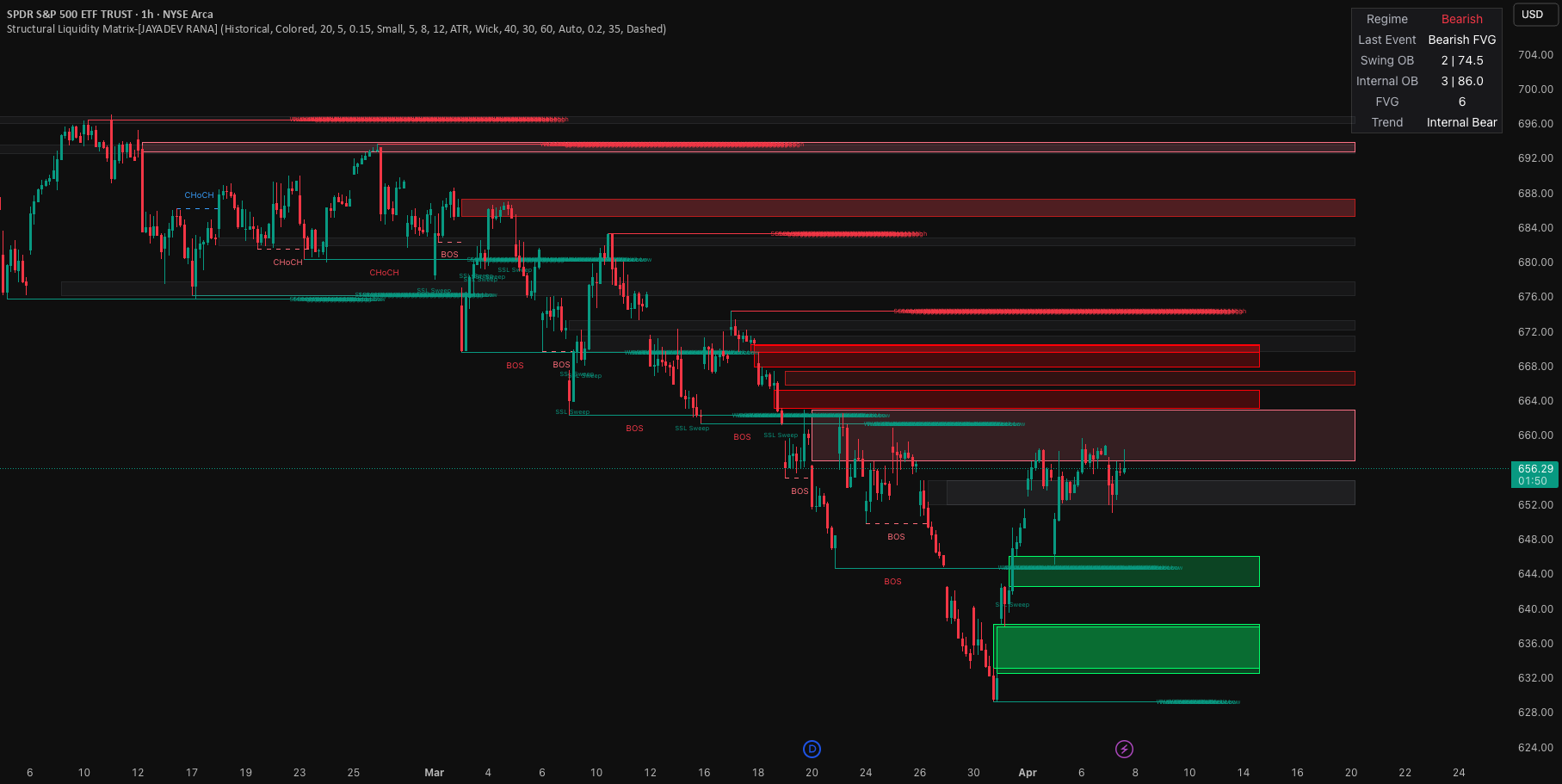
Structural Liquidity Matrix is a Pine Script v6 overlay indicator that maps market structure, liquidity events, order blocks, fair value gaps, higher-timeframe reference levels, and premium/discount zones directly on the chart. Overview This script brings several smart money concept style tools into one workflow. It tracks both swing and internal pivots, marks BOS and CHoCH breaks, highlights eq

Study Pine Script v6 AMEX:SPY 60
Open-sourcePublic TradingView release
Community25 likes · 356 views
Pinev6 · Study
Structural Liquidity Matrix TradingView preview by Jayadev Rana
Published
April 7, 2026
Community
25 likes · 356 views
Public signal
Open-source chart logic and on-platform visibility.
Why these public releases are worth looking at

These TradingView releases let traders see how Jayadev Rana thinks about signal design, chart clarity, alerts, and Pine structure before they decide whether they need a custom build.

Open original TradingView page

What this script is trying to do

Jayadev Rana published Structural Liquidity Matrix for free so traders can understand market structure, liquidity events, order blocks, fair value gaps, and premium-discount context without hiding the logic behind a paywall.

Traders who want smart-money-style context organized clearly on the chart, and buyers who want proof that Jayadev can turn complex ideas into usable Pine Script.

This script brings several smart money concept style tools into one workflow. It tracks both swing and internal pivots, marks BOS and CHoCH breaks, highlights equal highs and equal lows, detects liquidity sweeps, draws bullish and bearish order block zones, and identifies fair value gaps. It can also plot previous day, week, and month highs and lows, show premium/equilibrium/discount areas from the active swing range, color candles by detected trend state, and display a compact dashboard with the current regime and latest event.

How it works

- Swing structure is built from longer confirmed pivots to show the broader market leg. - Internal structure uses shorter pivots to track faster breaks and shifts in character. - When price breaks a confirmed structure level, the script labels the event as BOS or CHoCH. - After qualifying breaks, it searches back for the most relevant bullish or bearish order block and assigns a score before plotting the zone. - Liquidity sweeps are marked when price runs above a prior swing high or below a prior swing low and closes back through that level. - Fair value gaps are detected using a 3-candle imbalance condition and can remain visible until mitigation, depending on user settings. - Previous day, previous week, and previous month highs and lows can be displayed as context levels. - A dashboard summarizes regime, last event, active swing/internal order blocks, and active fair value gaps.

How to use it

- Use swing structure for broader directional context and internal structure for shorter-term shifts. - Use order blocks, fair value gaps, and sweep labels as reaction zones rather than automatic entry signals. - Use the higher-timeframe levels to frame intraday or swing decisions around prior session liquidity. - Use alerts on BOS, CHoCH, equal highs/lows, liquidity sweeps, and FVG detections after bar close confirmation.

Limitations and notes

- Swing and internal structure are based on confirmed pivots, so labels do not appear at the earliest possible bar. - Higher-timeframe levels depend on `request.security()` data from completed higher-timeframe candles. - Order block scoring and gap detection are rule-based filters. They are designed to organize price action, not to prove institutional intent. - This script is a chart-reading and context tool. It does not guarantee future market direction or trading performance.

Credits

This script was independently coded by Jayadev Rana.

Special credit to LuxAlgo for helping popularize smart money concept education and market structure terminology that inspired parts of this script's presentation. This script is not affiliated with or endorsed by LuxAlgo.

What you can learn from the public version

The original TradingView page gives traders two useful things at once: a working example on chart and a chance to inspect real Pine work instead of only reading service copy.

The visible controls already tell you a lot. Inputs such as Public source is available directly on TradingView. make it easier to understand what the script is trying to manage in live use.

Engineering notes from the script

  • Published as a TradingView indicator, which makes it easy for traders to inspect the logic, add it to chart, and decide whether they want a custom private version later.
  • This matters because traders can inspect real public TradingView work before deciding whether they need a custom paid build.

The public implementation shows real chart logic rather than a cosmetic placeholder. That matters because traders can inspect the work before they ask Jayadev Rana to build a custom private version.

Best use cases and practical caution

  • Reading BOS, CHoCH, internal structure, and swing structure in one workflow.
  • Using liquidity sweeps, order blocks, and fair value gaps as context instead of random chart clutter.
  • Seeing public proof that Jayadev Rana ships serious open-source work to help traders understand markets better before they ever buy custom development.

What to watch before you trust it live

  • This is a chart-reading and context tool, not a promise of future market direction.
  • Smart-money-style logic still needs trader judgment around session, confirmation, and risk execution.

What this says about the way Jayadev Rana works

There is a big difference between saying you write Pine Script and publishing work people can inspect on their own charts. These open-source releases show the public side of Jayadev Rana’s work: ideas shared freely, visible chart behavior, and clear explanations around what the script is doing.

If the free version gets close to what you want but not all the way there, the useful move is to treat it as a reference point. From there, the custom build can be shaped around cleaner rules, better safeguards, broker routing, or a more production-ready workflow.

liquiditysentimentsmartmoneytradingSMCTrend Analysis