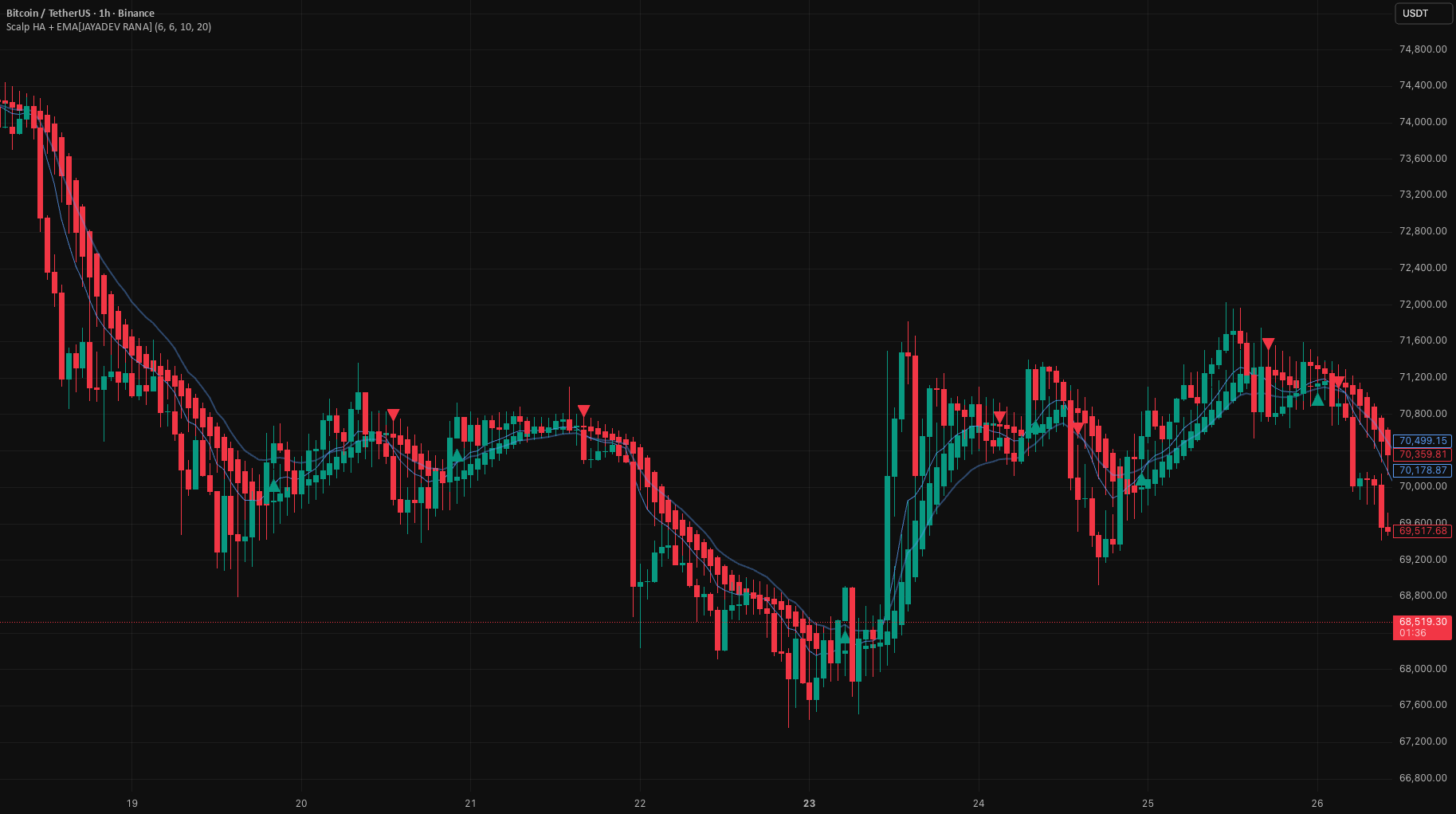
What this script is trying to do
Double-smoothed Heikin Ashi and EMA crossover confirmation for faster short-term reads.
Scalpers who want cleaner directional context without staring at noisy raw candles all day.
This script is a scalping-oriented visual overlay that combines two views of momentum:
Smoothed Heikin Ashi candles to clarify candle structure and reduce choppiness, and
EMA crossovers on the standard close for a secondary trend/confirmation layer.
The indicator is designed to help you read short-term regime changes quickly without relying on raw candles alone.
What you can learn from the public version
The original TradingView page gives traders two useful things at once: a working example on chart and a chance to inspect real Pine work instead of only reading service copy.
The visible controls already tell you a lot. Inputs such as Public source is available directly on TradingView. make it easier to understand what the script is trying to manage in live use.
Primary read (Smoothed HA candles):
Bullish candles: shaClose > shaOpen (colored with the Bullish Color).
Bearish candles: shaClose < shaOpen (colored with the Bearish Color).
A triangle prints when the candle state flips:
Up triangle below bar on bullish flip
Down triangle above bar on bearish flip
Confirmation read (EMA crossovers):
“Gold Cross”: fast EMA crosses above slow EMA
“Death Cross”: fast EMA crosses below slow EMA
EMAs can be toggled on/off via Show EMAs.
A common workflow is to treat the HA color flip as the timing trigger and use the EMA crossover as trend confirmation (or to filter trades in choppy sessions). Alternatively, you can invert that: use EMA trend as the regime and take only HA flips that align with it.
Engineering notes from the script
- Published as a TradingView indicator, which makes it easy for traders to inspect the logic, add it to chart, and decide whether they want a custom private version later.
- This matters because traders can inspect real public TradingView work before deciding whether they need a custom paid build.
Smoothed Heikin Ashi pipeline (two-stage smoothing):
Pre-smooth raw OHLC using EMA with Pre-Smoothing Period.
Compute Heikin Ashi from the smoothed OHLC:
HA close is the average of smoothed OHLC
HA open is recursively smoothed using prior HA values
HA high/low are derived from smoothed extremes and HA open/close
Post-smooth HA OHLC again using EMA with Post-Smoothing Period.
Plot candles using the post-smoothed HA values.
EMA crossover layer:
Fast EMA = EMA(close, Fast EMA Length)
Slow EMA = EMA(close, Slow EMA Length)
Crossovers are detected with ta.crossover() / ta.crossunder().
Best use cases and practical caution
- Lower-timeframe traders who want a clearer trend read before acting.
- Setups where candle color shift and moving-average confirmation should agree.
- Free community testing before commissioning a fully custom scalping stack.
What to watch before you trust it live
- Heavy smoothing improves clarity but adds lag.
- Sideways sessions can still whip both candle flips and EMA crosses.
Smoothed HA is intentionally lagging compared to raw candles; it’s built to reduce noise, not to predict turns early.
In ranging markets, both HA flips and EMA crossovers can whipsaw. Consider additional context (structure, session, volatility) or higher timeframe bias.
Alerts can trigger intrabar in real time and may differ from the final closed-bar state (standard TradingView behavior).
Screenshot prompt pack
Trend session example: A clean directional move on a lower timeframe (e.g., 5m/15m) showing extended same-color Smoothed HA candles with a supportive EMA alignment.
Flip + confirmation example: A sequence where HA flips bullish and the EMA gold cross happens shortly after; annotate as “trigger + confirmation.”
Chop warning example: A sideways segment where HA flips multiple times and EMAs cross back and forth; caption as a limitation (range whipsaw).
Sensitivity comparison: Same symbol/timeframe with (a) low smoothing periods and (b) higher smoothing periods to show the lag vs noise tradeoff.
What this says about the way Jayadev Rana works
There is a big difference between saying you write Pine Script and publishing work people can inspect on their own charts. These open-source releases show the public side of Jayadev Rana’s work: ideas shared freely, visible chart behavior, and clear explanations around what the script is doing.
If the free version gets close to what you want but not all the way there, the useful move is to treat it as a reference point. From there, the custom build can be shaped around cleaner rules, better safeguards, broker routing, or a more production-ready workflow.
Exponential Moving Average (EMA)