WhatsAppFast quote
Open-Source Expansion and Momentum Tool

Entropy-Driven Squeeze
Free on TradingView

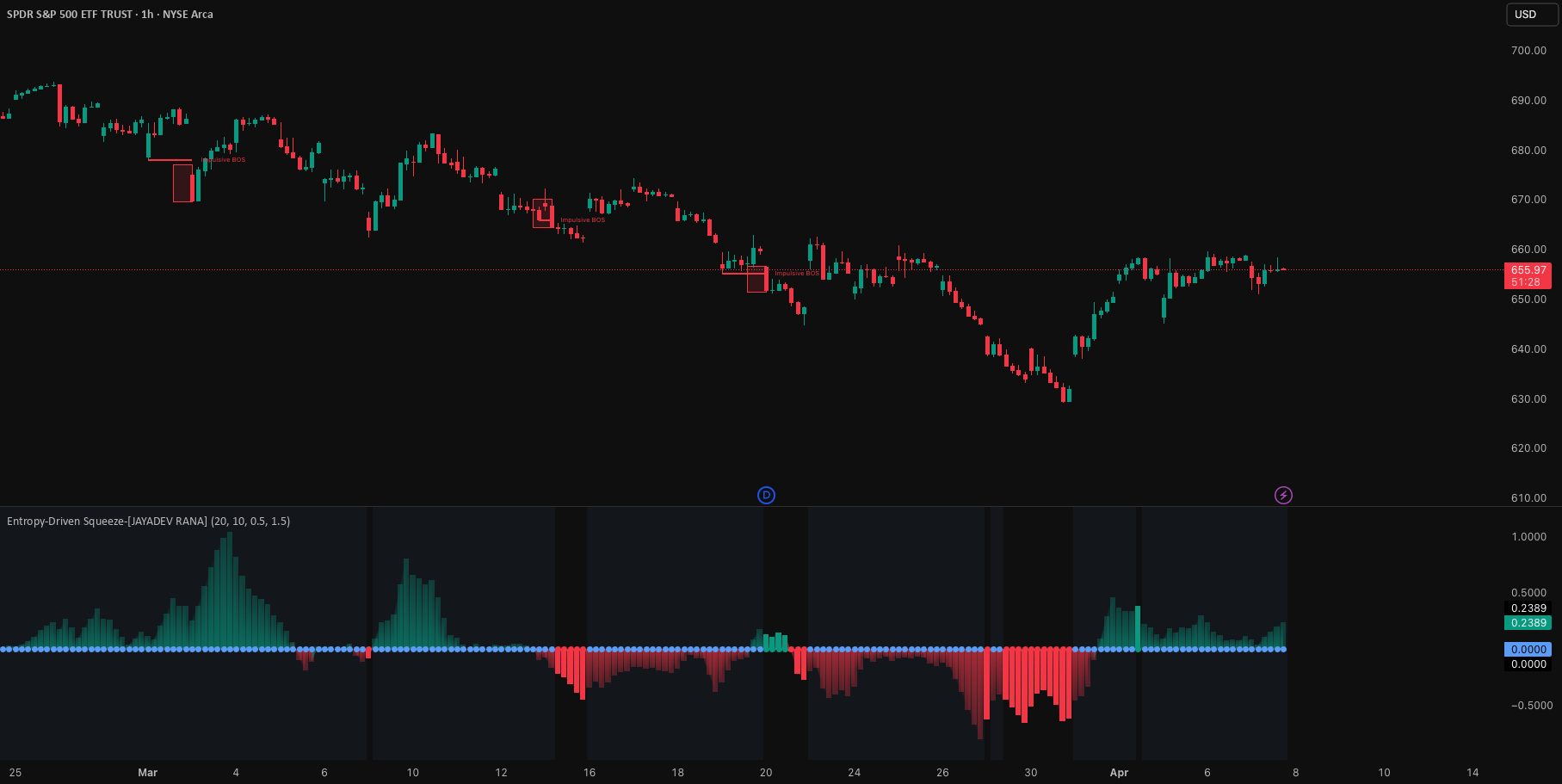
Entropy-Driven Squeeze is a Pine Script v6 oscillator that combines an efficiency-based squeeze state with VWAP-relative momentum and impulsive break-of-structure overlays. Overview This script is built to separate choppy compression from directional expansion, then pair that state with a normalized momentum read. The oscillator runs in its own pane, while structural break markers and displaceme

Study Pine Script v6 AMEX:SPY 60
Open-sourcePublic TradingView release
Community6 likes · 162 views
Pinev6 · Study
Entropy-Driven Squeeze TradingView preview by Jayadev Rana
Published
April 7, 2026
Community
6 likes · 162 views
Public signal
Open-source chart logic and on-platform visibility.
Why these public releases are worth looking at

These TradingView releases let traders see how Jayadev Rana thinks about signal design, chart clarity, alerts, and Pine structure before they decide whether they need a custom build.

Open original TradingView page

What this script is trying to do

Jayadev Rana published Entropy-Driven Squeeze for free so traders can understand compression, expansion, VWAP-relative momentum, impulsive BOS confirmation, and displacement zones in a cleaner structured way.

Traders who want to separate noisy chop from real expansion, and buyers who want proof that Jayadev can convert advanced market-behavior ideas into usable Pine Script tools.

This script is built to separate choppy compression from directional expansion, then pair that state with a normalized momentum read. The oscillator runs in its own pane, while structural break markers and displacement zones can be projected on the main chart using overlay drawings.

The squeeze logic is based on price efficiency over a user-defined lookback. When price travels a short net distance relative to the total path taken, the script treats that condition as a higher-chaos compression state. When efficiency improves, the script shifts toward expansion. Momentum is then measured as the distance between price and VWAP, smoothed with an EMA and normalized by ATR.

How it works

- It calculates an efficiency ratio over the selected lookback to estimate whether price is compressing or expanding. - It measures momentum as the smoothed distance between price and VWAP. - It normalizes momentum with ATR so the histogram is easier to compare across changing volatility conditions. - It flags impulsive candles when the current range exceeds an ATR-based displacement threshold. - It tracks recent 20-bar highs and lows, then marks an impulsive BOS only when price closes through one of those levels during a displacement candle. - It can draw simple displacement boxes on the chart when those BOS events occur.

How to use it

- Use the histogram to read directional momentum relative to VWAP. - Use the pulse marker and background highlight to identify tighter compression phases. - Use impulsive BOS markers as confirmation that expansion has started with enough range to matter. - Treat the displacement boxes as reaction zones for follow-through or retest analysis, not as automatic trade signals.

Limitations and notes

- The script uses an efficiency-ratio style squeeze model. It is entropy-inspired, but it is not a formal statistical entropy calculation. - BOS detection is based on recent rolling highs and lows, so signals depend on the selected lookback and current candle expansion. - The displacement boxes are simplified visual zones built from the impulsive break area. - This script is a decision-support tool. It does not guarantee future market direction or trading performance.

What you can learn from the public version

The original TradingView page gives traders two useful things at once: a working example on chart and a chance to inspect real Pine work instead of only reading service copy.

The visible controls already tell you a lot. Inputs such as Public source is available directly on TradingView. make it easier to understand what the script is trying to manage in live use.

Engineering notes from the script

  • Published as a TradingView indicator, which makes it easy for traders to inspect the logic, add it to chart, and decide whether they want a custom private version later.
  • This matters because traders can inspect real public TradingView work before deciding whether they need a custom paid build.

The public implementation shows real chart logic rather than a cosmetic placeholder. That matters because traders can inspect the work before they ask Jayadev Rana to build a custom private version.

Best use cases and practical caution

  • Reading squeeze conditions before expansion instead of reacting late to already-extended moves.
  • Combining VWAP-relative momentum with impulsive BOS markers and displacement boxes in one public workflow.
  • Seeing open-source proof that Jayadev Rana can turn complex market concepts into practical tools that help traders understand price better.

What to watch before you trust it live

  • This is an entropy-inspired squeeze model, not a formal statistical entropy engine.
  • Expansion markers and BOS confirmation still need session awareness, structure context, and disciplined execution around them.

What this says about the way Jayadev Rana works

There is a big difference between saying you write Pine Script and publishing work people can inspect on their own charts. These open-source releases show the public side of Jayadev Rana’s work: ideas shared freely, visible chart behavior, and clear explanations around what the script is doing.

If the free version gets close to what you want but not all the way there, the useful move is to treat it as a reference point. From there, the custom build can be shaped around cleaner rules, better safeguards, broker routing, or a more production-ready workflow.

entropysqueezemomentumWave Analysis