WhatsAppFast quote
Open-Source Volume Pressure Tool

Buy/Sell Volume Analysis
Free on TradingView

Buy/Sell Volume Analysis is a Pine Script v6 overlay indicator that estimates buying and selling pressure from candle structure, filters crossover signals with average volume, and tracks cumulative volume during a selected session. Overview This script is designed to give a simple view of bar-level volume pressure without leaving the main chart. It estimates how much of each bar's volume belongs

Study Pine Script v6 AMEX:SPY 60
Open-sourcePublic TradingView release
Community11 likes · 171 views
Pinev6 · Study
Buy/Sell Volume Analysis TradingView preview by Jayadev Rana
Published
April 8, 2026
Community
11 likes · 171 views
Public signal
Open-source chart logic and on-platform visibility.
Why these public releases are worth looking at

These TradingView releases let traders see how Jayadev Rana thinks about signal design, chart clarity, alerts, and Pine structure before they decide whether they need a custom build.

Open original TradingView page

What this script is trying to do

Jayadev Rana published Buy/Sell Volume Analysis for free so traders can read candle-based buying and selling pressure, session participation, and short-term control shifts without needing a complicated order-flow stack.

Traders who want a simpler way to read volume pressure on-chart, and buyers who want proof that Jayadev can turn practical market questions into clear Pine Script tools.

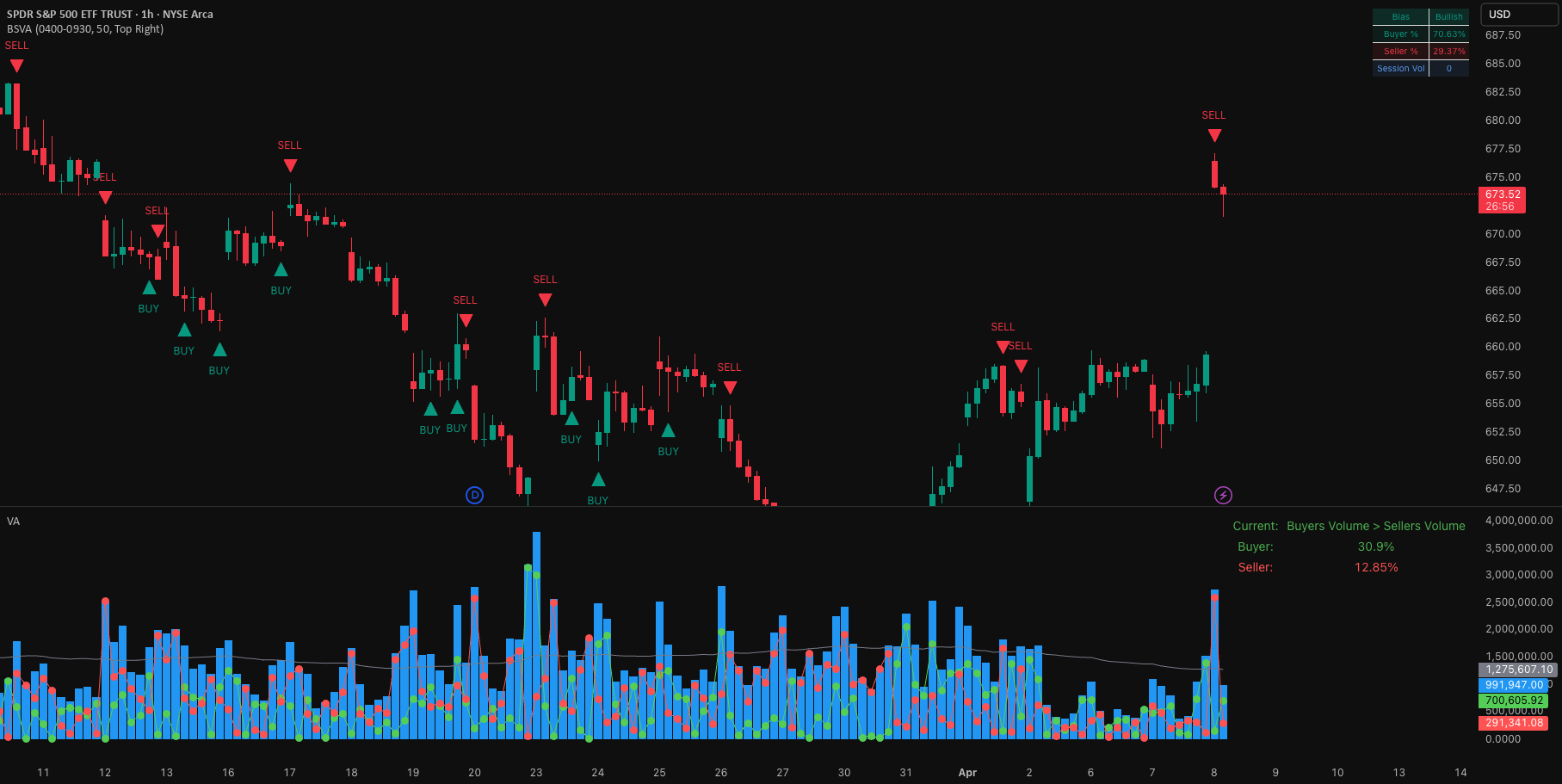
This script is designed to give a simple view of bar-level volume pressure without leaving the main chart. It estimates how much of each bar's volume belongs to buyers and sellers based on the candle's position inside its high-low range, then compares those two values to detect shifts in short-term control.

It also tracks cumulative volume inside a user-defined session window and displays the current bias, buyer percentage, seller percentage, and session volume in a compact dashboard.

How it works

- It checks whether the current bar is inside the selected session. - It estimates buying volume from the distance between the close and the low of the bar. - It estimates selling volume from the distance between the high and the close of the bar. - It calculates an SMA of total volume to use as a confirmation filter. - A buy signal appears when estimated buying volume crosses above estimated selling volume and total volume is above the average. - A sell signal appears when estimated selling volume crosses above estimated buying volume and total volume is above the average. - The dashboard updates with the current buyer percentage, seller percentage, directional bias, and cumulative session volume.

How to use it

- Use the BUY and SELL markers as short-term participation shifts, not as standalone trade instructions. - Use the buyer and seller percentages to judge whether the current bar is closing with stronger bullish or bearish pressure. - Use session volume tracking when you want to monitor activity during a specific market window such as premarket, open, or any custom session. - Use the volume SMA filter to avoid weaker crossover signals during low-activity bars.

Limitations and notes

- Buying and selling volume in this script are estimated from candle structure. They are not true bid/ask or order flow measurements from exchange data. - The signal logic is bar-based and can change until the bar closes. - Results can vary by symbol, timeframe, and session setting. - This script is intended as a chart-reading aid, not a guarantee of future price direction or trading performance.

What you can learn from the public version

The original TradingView page gives traders two useful things at once: a working example on chart and a chance to inspect real Pine work instead of only reading service copy.

The visible controls already tell you a lot. Inputs such as Public source is available directly on TradingView. make it easier to understand what the script is trying to manage in live use.

Engineering notes from the script

  • Published as a TradingView indicator, which makes it easy for traders to inspect the logic, add it to chart, and decide whether they want a custom private version later.
  • This matters because traders can inspect real public TradingView work before deciding whether they need a custom paid build.

The public implementation shows real chart logic rather than a cosmetic placeholder. That matters because traders can inspect the work before they ask Jayadev Rana to build a custom private version.

Best use cases and practical caution

  • Reading estimated buyer versus seller pressure directly from candle structure on the main chart.
  • Watching session-specific cumulative volume and directional bias during important market windows.
  • Using Jayadev Rana’s open-source work to understand market participation better before requesting a private custom build.

What to watch before you trust it live

  • This tool estimates buy and sell pressure from candle structure. It is not true bid-ask order-flow data.
  • Signals are bar-based and can change before the candle closes, so confirmation still matters.

What this says about the way Jayadev Rana works

There is a big difference between saying you write Pine Script and publishing work people can inspect on their own charts. These open-source releases show the public side of Jayadev Rana’s work: ideas shared freely, visible chart behavior, and clear explanations around what the script is doing.

If the free version gets close to what you want but not all the way there, the useful move is to treat it as a reference point. From there, the custom build can be shaped around cleaner rules, better safeguards, broker routing, or a more production-ready workflow.

OscillatorsPositive Volume Index (PVI)