Zack-Style 3D Explainer Shorts in Headless Blender
A measured formula from 3,973 Shorts turned into a headless Blender pipeline with mocap humans and dual-language voiceover.
Research found one continuous camera move, 170 words per minute and a sky-blue void; the pipeline renders side-by-side scenes with jump cuts, MakeHuman CC0 characters retargeted from CMU motion capture, Poly Haven assets, and English plus Hindi tracks.
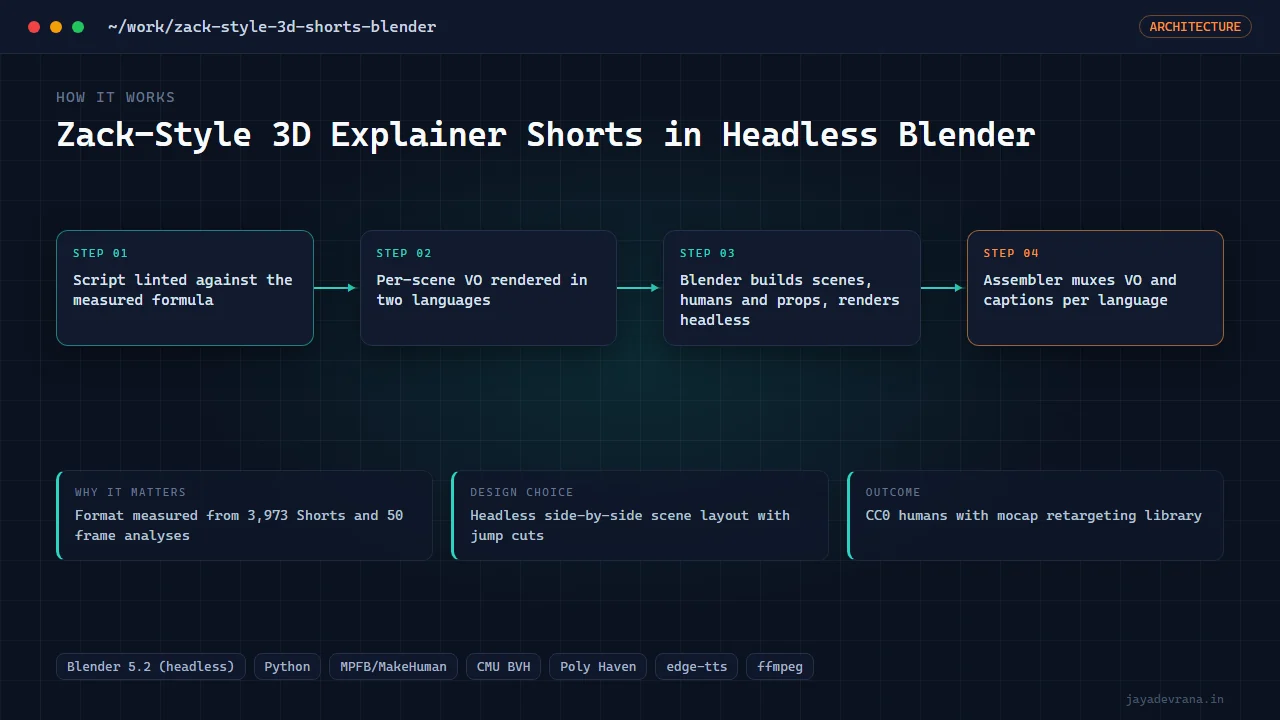
- Format measured from 3,973 Shorts and 50 frame analyses
- Headless side-by-side scene layout with jump cuts
- CC0 humans with mocap retargeting library
- English and Hindi tracks from one scene file
Rather than imitate a popular explainer-Shorts channel by eye, the format was measured: thousands of titles ranked, fifty videos frame-analysed, transcripts timed. The findings overturned the initial assumptions: about 170 words per minute with the first word at zero seconds, mostly one continuous camera move with a median of one cut, a specific sky-blue gradient void, semi-realistic humans rather than cartoon ones, and colour-coded effects for pain and tissue. The formula is encoded in a skill with a lint script.
The render pipeline runs Blender headless. Per-scene voice clips in two languages set scene lengths, scenes are laid out side by side in one file so a single camera jump-cuts between them, and an assembler adds delayed voiceover and three-word caption chunks. A realistic pass pulls CC0 glTF props, HDRIs and textures from Poly Haven and builds screens as emission planes.
Humans come from a reusable library: MakeHuman CC0 characters created through the MPFB extension with a rig whose bone names match the CMU motion-capture archive, so a BVH clip retargets directly. The traps that silently break it are recorded (hidden source armatures freeze motion, stacked IK constraints cancel, a bone-parented IK target creates a dependency cycle that renders black). Medical topics are rendered as stylised animation by my rule, never photoreal.
How it works
- Script linted against the measured formula
- Per-scene VO rendered in two languages
- Blender builds scenes, humans and props, renders headless
- Assembler muxes VO and captions per language