TradingView Auto-Publish Toolkit and Original Script Batches
CDP scripts that stage, optimise, verify and publish Pine scripts on TradingView Desktop, used to ship 17 original public scripts in three batches.
New-script staging, tester-driven grid optimisation with IS/OOS split, numeric on-chart verification, description and category filling, platform-limit handling, plus the AlgoAlpha-style ideation skill built from 134 open-source scripts.
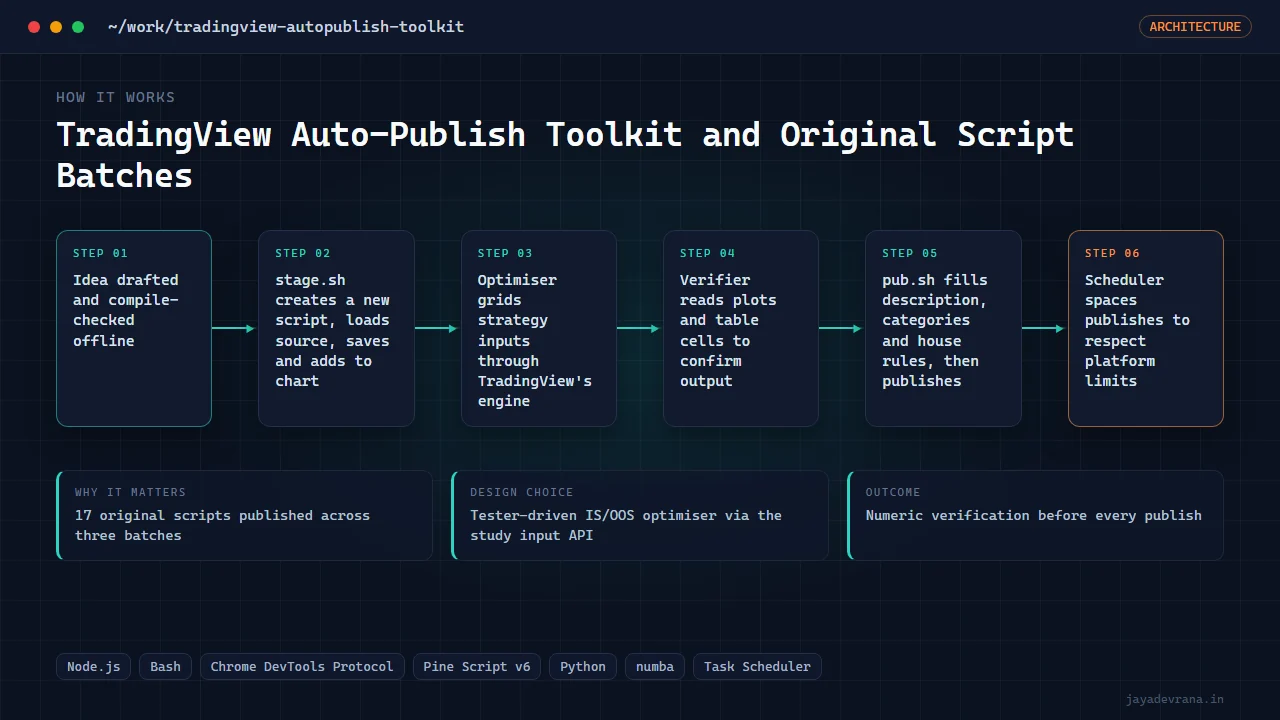
- 17 original scripts published across three batches
- Tester-driven IS/OOS optimiser via the study input API
- Numeric verification before every publish
- AlgoAlpha-style ideation skill with a shuffled-baseline probe
Publishing a TradingView script properly involves a dozen fiddly steps: create a fresh script without touching the open draft, load source, save, add to chart, verify it actually plots numbers, write a moderation-safe description, pick categories, tick house rules and publish. The toolkit automates all of it against TradingView Desktop over the DevTools Protocol, pinned to a scratch layout so my working chart is never touched.
Its optimiser drives TradingView's own engine through the study input API, splitting in-sample and out-of-sample by trade exit time at about two seconds per combination; a numba stop-and-reverse optimiser handles signal indicators on exported bars and matched on-chart counts exactly. Platform limits were discovered and encoded: five public scripts per 24 hours and fifteen per rolling thirty days.
Three batches shipped: six trend-following scripts, six data-driven originals (session auction profile, delta exhaustion, Markov regime matrix, relative-strength rotation, multi-timeframe liquidity pools, compression-expansion ladder) and five famous-trader method indicators (Minervini, Williams, Raschke, Dennis, Darvas) with a shared trade-journal layer of entry, stop and target lines and a results table. A companion skill reverse-engineered the design language of 134 AlgoAlpha open-source scripts into a style DNA, an idea matrix and a signal probe with a shuffled baseline, with the rule that no accuracy is claimed without an edge flag.
How it works
- Idea drafted and compile-checked offline
- stage.sh creates a new script, loads source, saves and adds to chart
- Optimiser grids strategy inputs through TradingView's engine
- Verifier reads plots and table cells to confirm output
- pub.sh fills description, categories and house rules, then publishes
- Scheduler spaces publishes to respect platform limits
Software and automation are infrastructure, not financial advice. No performance guarantees. Every live system needs staged testing, risk limits, and owner approval.