Prop-Firm Hedge Research: Math, Live Harness and Income Model
The FTMO-versus-real-account hedge idea solved on 42.8 million gold ticks, tested live with two EAs, and priced honestly.
Constant per-stage hedge ratios proven exact on tick data, a master/copier EA pair across two brokers that exposed five bugs no backtest shows, and an income model that found the real profit engine and the real costs.
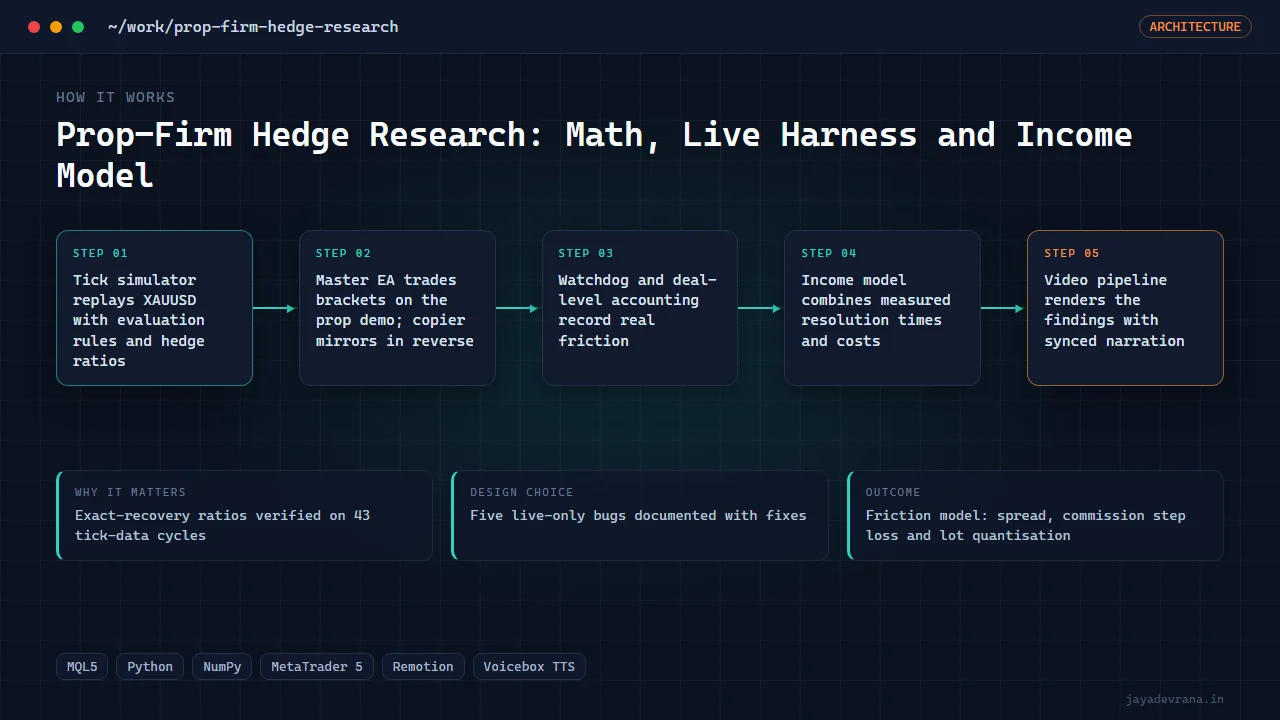
- Exact-recovery ratios verified on 43 tick-data cycles
- Five live-only bugs documented with fixes
- Friction model: spread, commission step loss and lot quantisation
- Explainer video with sentence-anchored scenes
Can a prop-firm evaluation be made risk-free by reverse-copying it on a real account? This project answered with numbers instead of opinions. A tick simulator over 42.8 million XAUUSD ticks showed that constant per-stage hedge ratios give exactly zero on every failed evaluation and a fixed gain on every pass under perfect fills; dynamic ratios blow up near the barrier.
A two-EA live harness then ran a rule-based bracket trader on a prop demo and a reverse copier on a second broker's demo. It exposed problems only live trading shows: hedge stops must anchor to the hedge's own fill because brokers quote gold up to a dollar apart; global variables vanish on a force-kill, so phase state and the position map must persist to files; a filled order does not appear in the position count immediately, so an in-flight latch is needed or the EA doubles its risk; and an EA's P&L must be summed from its own deals, never the account balance.
The income model folded in measured friction. The master's own spread turns each trade into an unfair coin, commission can cost a whole extra step unless the last trade is sized to land on target, and lot-step quantisation silently ignores small ratio changes. The conclusion: the hedge only makes the evaluation roughly free; the profit engine is the funded account run unhedged. An 11-minute Remotion explainer tells the story with scenes anchored to narration sentence indices.
Research on demo accounts; shared as engineering work, not financial advice.
How it works
- Tick simulator replays XAUUSD with evaluation rules and hedge ratios
- Master EA trades brackets on the prop demo; copier mirrors in reverse
- Watchdog and deal-level accounting record real friction
- Income model combines measured resolution times and costs
- Video pipeline renders the findings with synced narration
Software and automation are infrastructure, not financial advice. No performance guarantees. Every live system needs staged testing, risk limits, and owner approval.