Local AI Video Stack: Wan 2.2, MiniMax H3 and LongCat Avatar on One GPU
Production drivers, measured timings and the silent failure modes of running three open video models locally through ComfyUI.
Deterministic shot specs with character tokens and seeds, Wan 2.2 dual-expert settings, H3 joint video-plus-audio generation with verified spoken lines, LongCat talking heads with four documented traps, and a Flux image path for site imagery.
- Deterministic shot specs with seeded rerolls
- H3 spoken lines verified by transcription
- LongCat drift and grin traps measured and fixed
- All timings measured on the actual GPU
Every video project here renders locally on a single 16 GB consumer GPU, and this stack is the shared foundation. Wan 2.2 runs through ComfyUI's HTTP API with dual-expert mixture-of-experts handoff, four distilled steps, 81 frames at 16 fps per shot, and shots submitted one at a time so both experts stay resident. Project folders follow one convention: shots, brand, thumbnails, rerolls and transcript JSON, with all-caps character tokens substituted from a cast map and deterministic seeds so targeted rerolls are reproducible. Byte-identical character descriptions are what prevent subject drift between cuts.
MiniMax H3 was verified generating video and native stereo audio jointly, including verbatim spoken lines confirmed by transcription, legible in-frame text and music; throwaway low-resolution generations double as free original music beds. Its frame grid, canvas limits and per-shot timings were measured so budgets come from a table rather than a formula. Reference-to-video and keyframe modes were found to be mutually exclusive.
LongCat Avatar 1.5 produces talking heads from a photo and audio at about 55 seconds of compute per second of output, with four traps documented: the negative prompt is inert at cfg 1, every window ends in a grin unless the tail is dropped, lip colour drifts over chained segments unless colour-matched, and the text encoder path must avoid an fp8 rejection. A Flux image path and an image-only CLI complete the toolkit.
How it works
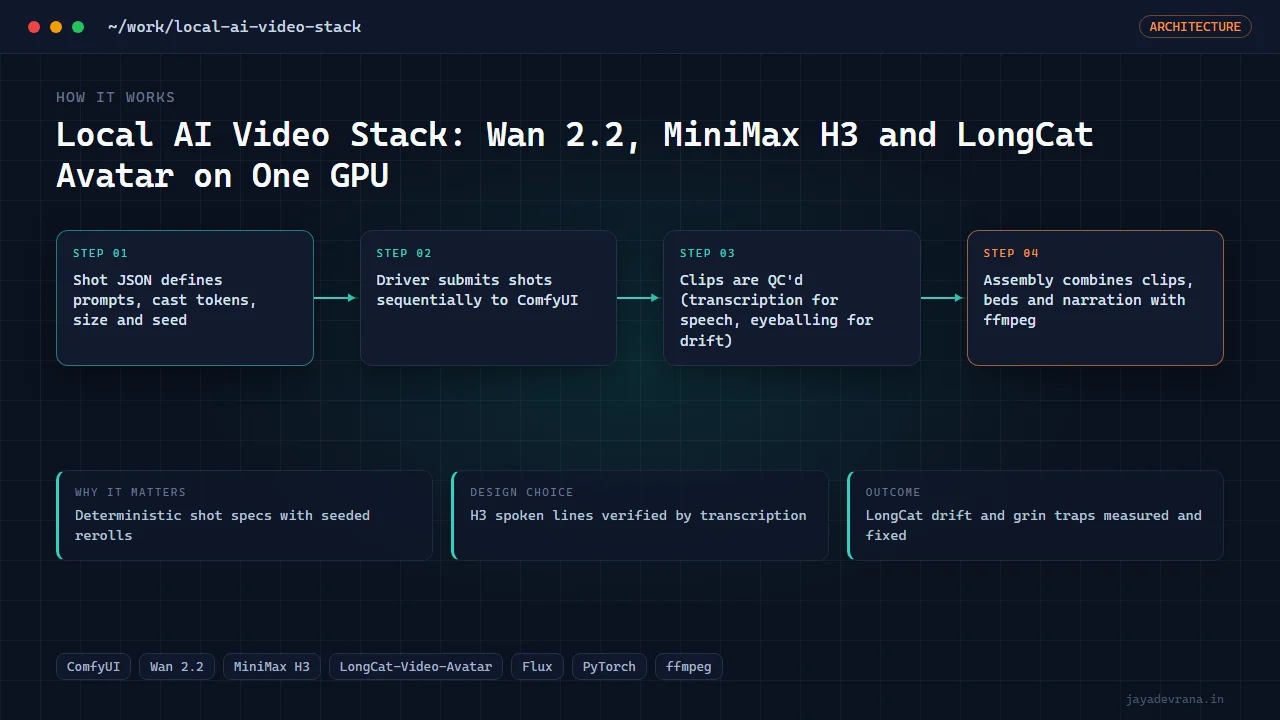
- Shot JSON defines prompts, cast tokens, size and seed
- Driver submits shots sequentially to ComfyUI
- Clips are QC'd (transcription for speech, eyeballing for drift)
- Assembly combines clips, beds and narration with ffmpeg