AI YouTube Documentary Engine
A pipeline that produces a finance documentary end-to-end, from topic to finished MP4.
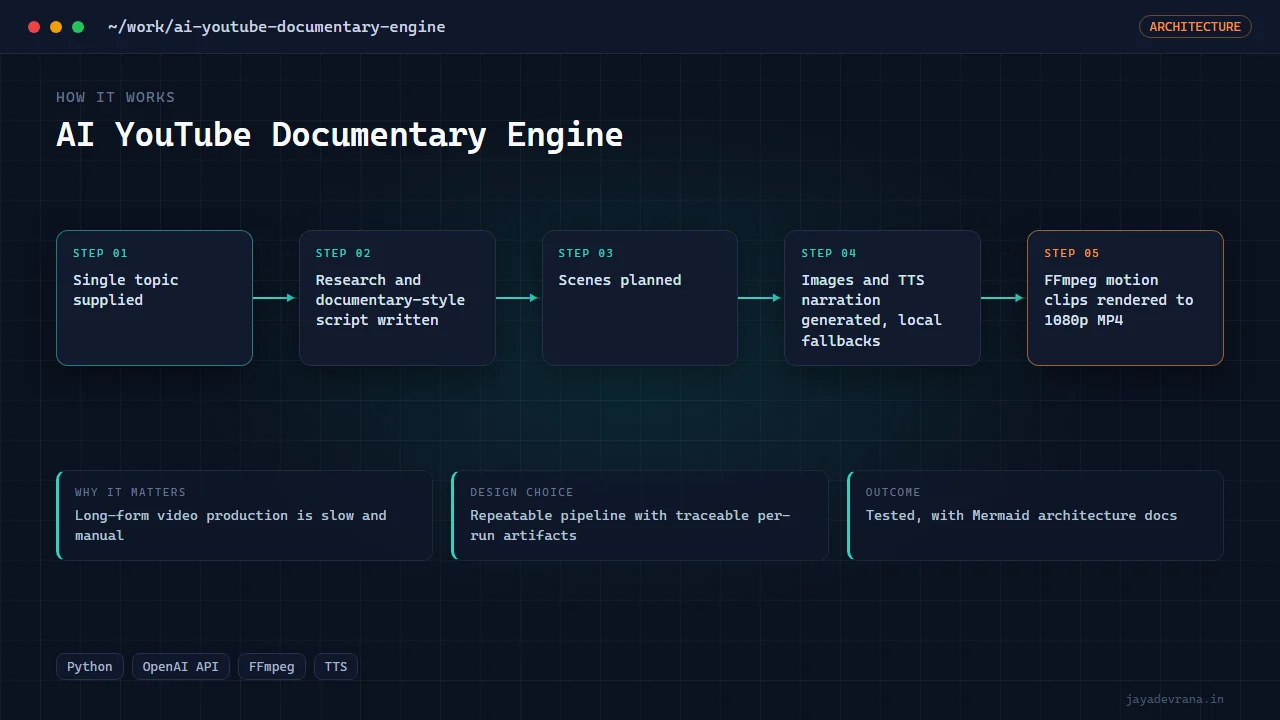
Topic research to a documentary-style script to scene planning to image and TTS generation to FFmpeg motion to a 1080p export.
- Topic research to full documentary script
- Scene planning with image and TTS generation, plus local fallbacks
- FFmpeg motion clips assembled into a 1080p MP4
- Tested, with traceable build artifacts per run
A Python pipeline that produces a finance-and-psychology YouTube documentary from a single topic, end to end. It researches the subject, writes a documentary-style script, plans scenes, generates images and narration (with local fallbacks when an API is unavailable), assembles FFmpeg motion clips, and renders a 1080p MP4 with optimized metadata ready to publish.
It is documented with a Mermaid architecture diagram, has a test suite, and keeps build artifacts under a runs directory so each production is traceable. This is the full script-to-published-video claim actually implemented — a repeatable factory for long-form video, not a one-off edit. Because every stage from research to render is scripted and tested, the pipeline can turn out a new documentary on a fresh topic repeatably, and the local fallbacks mean a missing API key degrades quality rather than halting the whole build.
Update (2026): Superseded in practice by a documentary skill built from a 10-channel benchmark study: a defamation-safe production bible, generated cinematic and music layers (no licensed music, no third-party footage), and narration-first assembly. The first full episode shipped at 14 minutes 25 seconds in 1080p from 28 generations with zero rerolls, a 55-piece assembly at broadcast loudness and a 22-source description; a review pass by two other model CLIs caught one factual error before publishing. A music-mixing standard (quiet beds, a speech-pocket EQ, single constant gain, two-pass loudness normalisation) was added afterwards.
How it works
- Single topic supplied
- Research and documentary-style script written
- Scenes planned
- Images and TTS narration generated, local fallbacks
- FFmpeg motion clips rendered to 1080p MP4