Snapshots
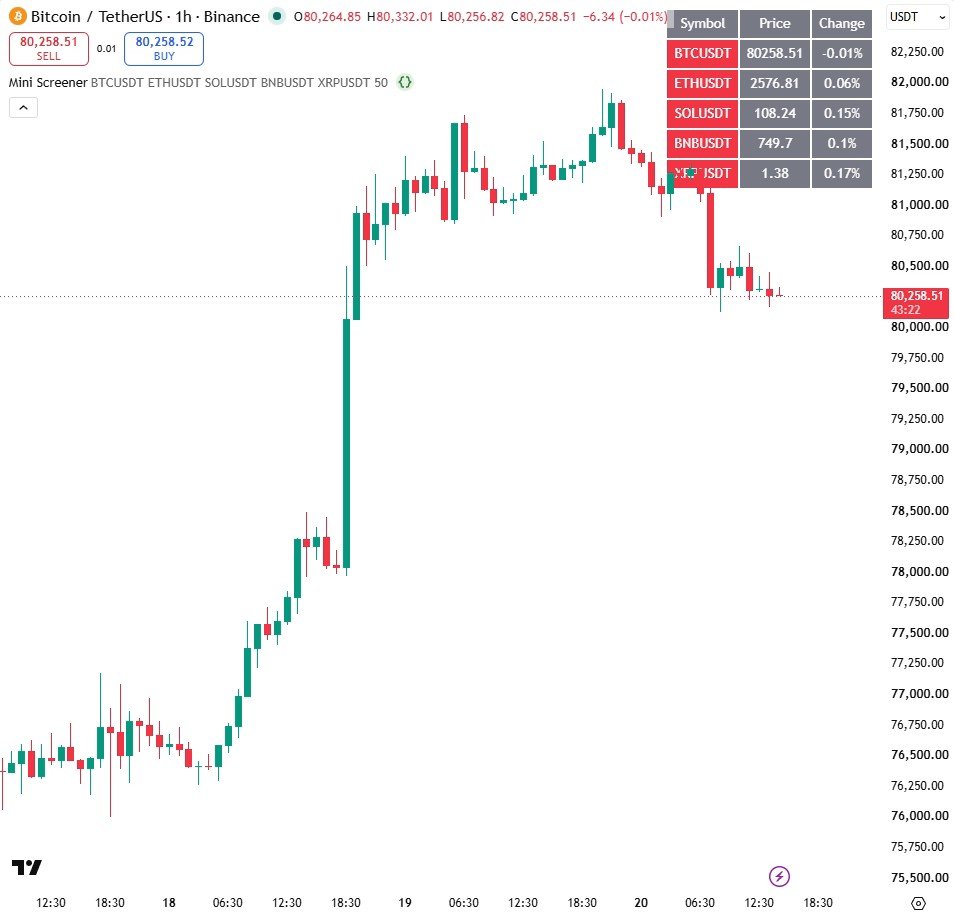
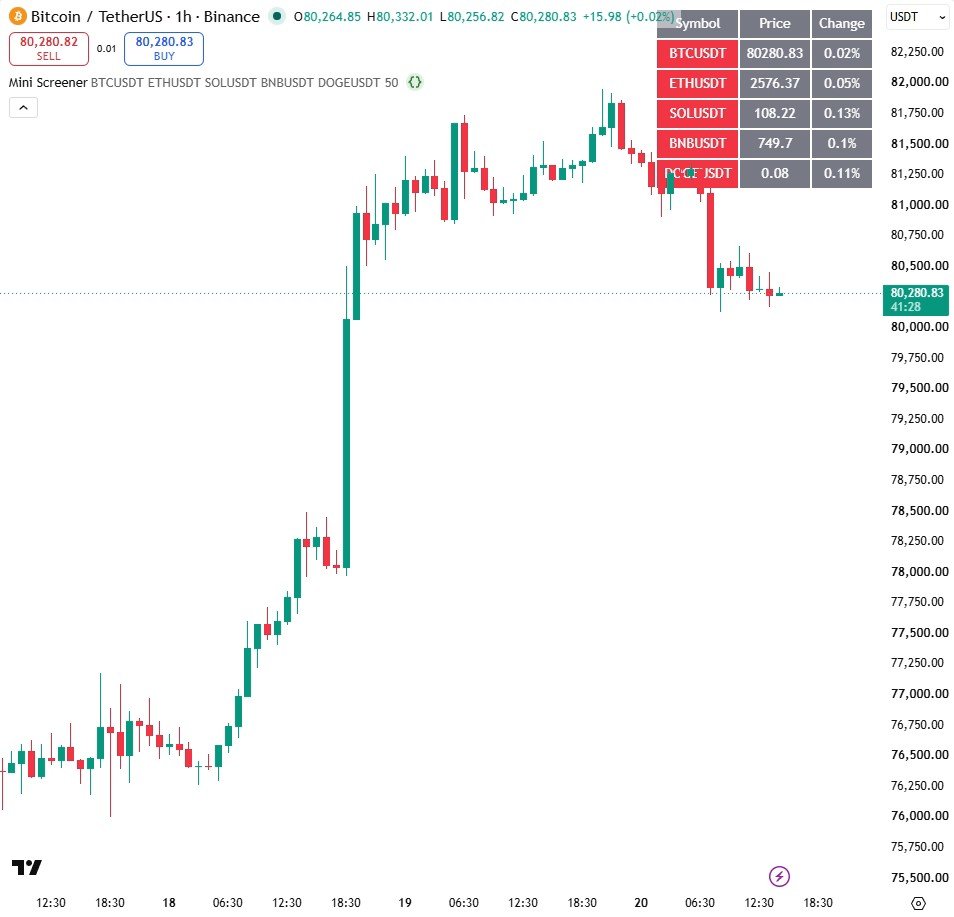
How it works
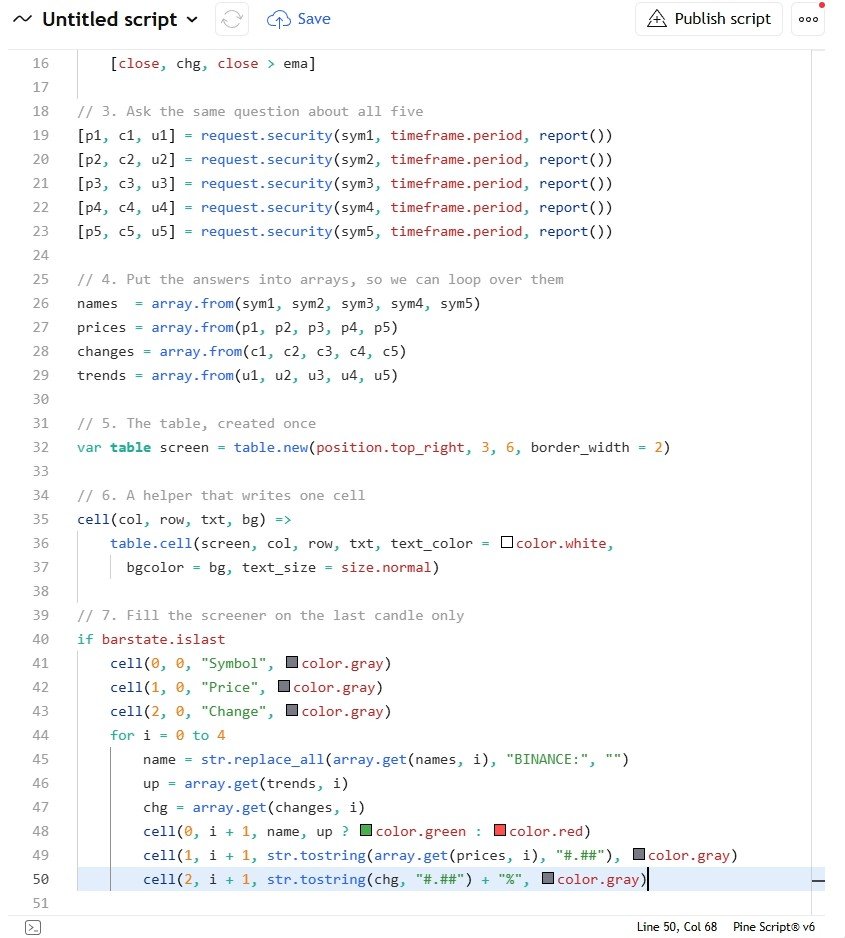
- One small function returns three answers in a bag: [close, change, above trend].
- request.security runs that function on each symbol you pick, so each call carries three values instead of one.
- array.from stores the answers and a for loop fills every row, so adding markets does not mean adding code.
Settings
| Setting | Default | What it does |
|---|---|---|
| Symbol 1 | BINANCE:BTCUSDT | First row of the screener |
| Symbol 2 | BINANCE:ETHUSDT | Second row |
| Symbol 3 | BINANCE:SOLUSDT | Third row |
| Symbol 4 | BINANCE:BNBUSDT | Fourth row |
| Symbol 5 | BINANCE:XRPUSDT | Fifth row |
| Trend average length | 50 | EMA used for the trend question on every symbol |
Source code
In TradingView: open the Pine Editor, create a new indicator, paste the code, then click "Add to chart".
//@version=6
indicator("Mini Screener", overlay = true)

// 1. Settings: five symbols and the trend length
sym1   = input.symbol("BINANCE:BTCUSDT", "Symbol 1")
sym2   = input.symbol("BINANCE:ETHUSDT", "Symbol 2")
sym3   = input.symbol("BINANCE:SOLUSDT", "Symbol 3")
sym4   = input.symbol("BINANCE:BNBUSDT", "Symbol 4")
sym5   = input.symbol("BINANCE:XRPUSDT", "Symbol 5")
emaLen = input.int(50, "Trend average length")

// 2. One question, asked about any symbol
report() =>
    ema = ta.ema(close, emaLen)
    chg = 100 * (close - close[1]) / close[1]
    [close, chg, close > ema]

// 3. Ask the same question about all five
[p1, c1, u1] = request.security(sym1, timeframe.period, report())
[p2, c2, u2] = request.security(sym2, timeframe.period, report())
[p3, c3, u3] = request.security(sym3, timeframe.period, report())
[p4, c4, u4] = request.security(sym4, timeframe.period, report())
[p5, c5, u5] = request.security(sym5, timeframe.period, report())

// 4. Put the answers into arrays, so we can loop over them
names  = array.from(sym1, sym2, sym3, sym4, sym5)
prices = array.from(p1, p2, p3, p4, p5)
changes = array.from(c1, c2, c3, c4, c5)
trends = array.from(u1, u2, u3, u4, u5)

// 5. The table, created once
var table screen = table.new(position.top_right, 3, 6, border_width = 2)

// 6. A helper that writes one cell
cell(col, row, txt, bg) =>
    table.cell(screen, col, row, txt, text_color = color.white,
      bgcolor = bg, text_size = size.normal)

// 7. Fill the screener on the last candle only
if barstate.islast
    cell(0, 0, "Symbol", color.gray)
    cell(1, 0, "Price", color.gray)
    cell(2, 0, "Change", color.gray)
    for i = 0 to 4
        name = str.replace_all(array.get(names, i), "BINANCE:", "")
        up = array.get(trends, i)
        chg = array.get(changes, i)
        cell(0, i + 1, name, up ? color.green : color.red)
        cell(1, i + 1, str.tostring(array.get(prices, i), "#.##"), color.gray)
        cell(2, i + 1, str.tostring(chg, "#.##") + "%", color.gray)
Watch it built
This script is written and explained step by step in the video lesson.
Need a custom indicator or strategy?
Non-repainting Pine Script v6, backtested with real costs, alert and webhook ready. Fixed quote within 24 hours.