Can You Hedge a Prop Firm Challenge With a Real Account? The Math
Can you hedge a prop firm challenge with a real account? Tick-level math says the evaluation becomes roughly free, not profitable: ratios, live bugs, costs.
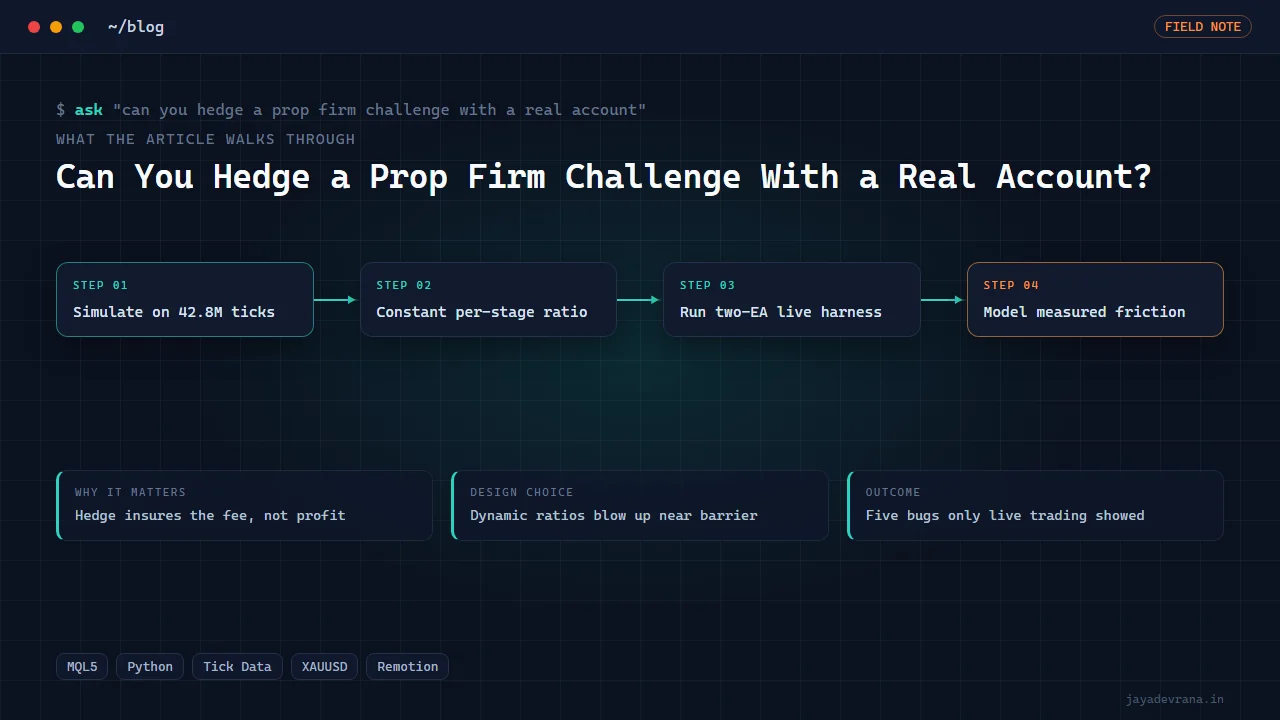
You can hedge a prop firm challenge with a real account in the sense that a reverse copy on a second broker can make the evaluation roughly cost-neutral under realistic conditions: the hedge pays back the evaluation fee when the challenge fails, and costs you a known slice of the funded upside when it passes. What you cannot do is turn the hedge itself into a profit engine. When I solved the problem on 42.8 million gold ticks and then ran it live across two brokers, the conclusion was that the hedge only makes the evaluation approximately free, and the profit, if any, comes from running the funded account unhedged afterwards.
That is a less exciting answer than the "infinite money" framing you see online, and it comes from arithmetic rather than opinion. This post lays out the math, the hedge ratio that works and the one that blows up, the five bugs that only appeared when real EAs traded real brokers, and the friction that eats the rest. The project behind it is my prop-firm hedge research, which also became an explainer video. Nothing here is financial advice; it is engineering and arithmetic about demo accounts, and anyone applying it does so on their own accounts, at their own risk and subject to their prop firm's terms.
What is the hedge supposed to achieve?
A prop evaluation is a fee paid for a chance at a funded account, with a profit target to pass and a drawdown limit that fails you. The hedge idea is to place the opposite trades on a real account at some ratio, so that when the evaluation hits its drawdown limit, the real account has gained roughly the fee back, and when the evaluation passes, the real account has lost a bounded amount that the funded account's first payout should cover. Framed properly, it is insurance against the fee, not a money machine.
Whether that insurance is worth buying depends on the ratio, the costs and the pass rate, and each of those has a number.
What hedge ratio works, and why do dynamic ratios fail?
I built a tick simulator that replays XAUUSD ticks with the evaluation rules (target, daily and overall drawdown) and a hedge at a chosen ratio, and ran it over 42.8 million ticks across many evaluation cycles. The result that held up:
- Constant per-stage ratios give exactly zero net outcome on every failed evaluation and a fixed, known gain on every pass, under perfect fills. The ratio is set once per stage (first evaluation phase, second phase, funded) from the stage's target and drawdown, and never changes mid-stage.
- Dynamic ratios, which increase the hedge as the evaluation nears its drawdown barrier, blow up. Near the barrier the required ratio grows without bound, and a few ticks of adverse movement on the hedge side produce losses that dwarf the fee. They look clever in a spreadsheet and fail on tick data.
The constant-ratio proof was verified on 43 complete tick-data cycles. That is the solved part. Everything after it is about why the live result is worse than the proof.
What goes wrong when you run it live across two brokers?
A two-EA harness ran a rule-based bracket trader on a prop firm's demo and a reverse copier on a second broker's demo. Five problems appeared that no backtest shows:
- Hedge stops must anchor to the hedge's own fill. Brokers quote gold up to a dollar apart. A stop computed from the master's price lands in the wrong place on the hedge broker and can be hit by spread alone.
- State must persist to files. Global variables vanish when the terminal is force-killed. Phase state and the master-to-hedge position map have to be written to disk and reloaded, or a restart orphans every hedge.
- Filled orders do not appear in the position count immediately. The copier can see a fill, check positions, see nothing yet, and send a second hedge. An in-flight latch is needed or the EA doubles its risk.
- P&L must be summed from the EA's own deals. Reading the account balance mixes in other activity, swaps and corrections; the hedge math needs the EA's own closed-deal total.
- Master and copier see different sessions. Session open times, spread widening and symbol suffixes differ between brokers, so the copier needs its own symbol mapping and session checks.
Each of these was fixed and documented. Together they are why "just run a copier in reverse" is not a plan.
How much does friction change the answer?
The income model folded measured costs into the ratio math, and three effects dominated:
- The master's own spread turns each trade into an unfair coin. Every trade on the evaluation pays spread, so the pass probability is lower than a fair model assumes, which raises the expected number of evaluations per pass and therefore the total hedge cost.
- Commission can cost a whole extra step. Near the target, commission on the final trade can leave the evaluation a fraction short, forcing another trade and another round of risk, unless the last trade is sized to land exactly on target.
- Lot-step quantisation silently ignores small ratio changes. The hedge volume is rounded to the broker's lot step, so the theoretical ratio and the traded ratio differ, and on small accounts the difference is material.
With those included, the hedge still roughly neutralises the evaluation fee over many cycles, but it never adds profit. The funded account, run without a hedge because hedging it would cancel its upside, is the only place the model finds income, and that income is simply the funded payout discounted by the pass rate and time to resolution.
So is it worth doing?
As fee insurance, under the constant-ratio rule, with the five live fixes in place, and with eyes open about friction, it can be roughly break-even over many evaluations. As a strategy, no. The model also says nothing about whether a given prop firm permits it, and many prohibit hedging across accounts or copy trading in their terms; that is a contractual question you must answer yourself before any of this engineering matters.
How I built this: Prop-Firm Hedge Research: Math, Live Harness and Income Model
The prop-firm hedge research project set out to replace opinions about the hedge idea with numbers. The workflow:
- Tick simulator in Python. XAUUSD ticks were replayed through the evaluation rules with hedge ratios applied, across many cycles, to test constant and dynamic ratio schemes. Constant per-stage ratios proved exact on 43 cycles; dynamic ratios diverged near the barrier.
- Master EA in MQL5. A rule-based bracket trader ran on the prop firm's demo account, writing its phase state and open brackets to files so a restart could resume.
- Reverse copier EA on a second broker. The copier mirrored each master trade in reverse at the stage ratio, anchoring its stops to its own fills, mapping symbols between brokers, and holding an in-flight latch to prevent double hedges.
- Watchdog and deal-level accounting. Both EAs summed profit from their own closed deals rather than account balance, and a watchdog recorded every discrepancy, which is how the five live-only bugs were found and fixed.
- Income model. Measured resolution times, pass rates under spread, commission step loss and lot quantisation were combined into a model of expected income per slot, which located the real profit engine in the unhedged funded account.
- Explainer video. An eleven-minute Remotion video tells the story, with each scene anchored to a sentence index in the narration so the visuals stay synchronised when the script changes.
The design decisions: prove the ratio on ticks before writing a single EA, treat the live harness as a bug-finding instrument rather than a demonstration, and let the income model include every measured cost even when it makes the conclusion duller. The outcome is a documented answer, a pair of EAs with the restart, latch and accounting fixes built in, and a model that tells you what the hedge can and cannot do. If you are building any cross-broker EA pair, the backtest-versus-live lessons in why MT5 EA backtests differ from live apply directly.
FAQ
Does the hedge need to be on gold?
No. Gold was chosen because tick data was abundant and spreads differ sharply between brokers, which stresses the hedge. The ratio math is instrument-independent; the friction numbers are not, so each instrument needs its own measurement.
Can I hedge a funded account the same way?
You can, but the model shows it removes the only source of income. Hedging the funded account at the stage ratio neutralises its payout the same way it neutralises the evaluation loss. The research treats the funded stage as the place to carry risk, not to hedge it.
Why not just use a commercial trade copier?
A general copier does not know about stages, ratios, barrier distance or the latch problem, and it typically reads the account balance for P&L. The copier here is a small purpose-built EA because the hedge logic is the product, not the copying.
Is any of this allowed by prop firms?
Many prop firms prohibit hedging between their accounts and external accounts, copy trading, or both, and enforce it with trade-pattern analysis. This research is about whether the math works on demo accounts, not about whether a specific firm permits it. Read the terms of any firm you deal with before acting on anything here.
If you want cross-broker EA work, a tick-level simulation of a risk idea, or an honest income model before you commit capital, tell me on the contact page.
Building something in this space? I ship trading automation, Pine Script, MQL5 EAs, and full-stack tools with source and docs.
Start a project →