Can You Connect to MT5 Without Running the Terminal? A Protocol Bridge
Can you connect to MT5 without running the terminal? Yes, by speaking the broker protocol directly: 53 MB per account, seconds to log in, no Windows host.
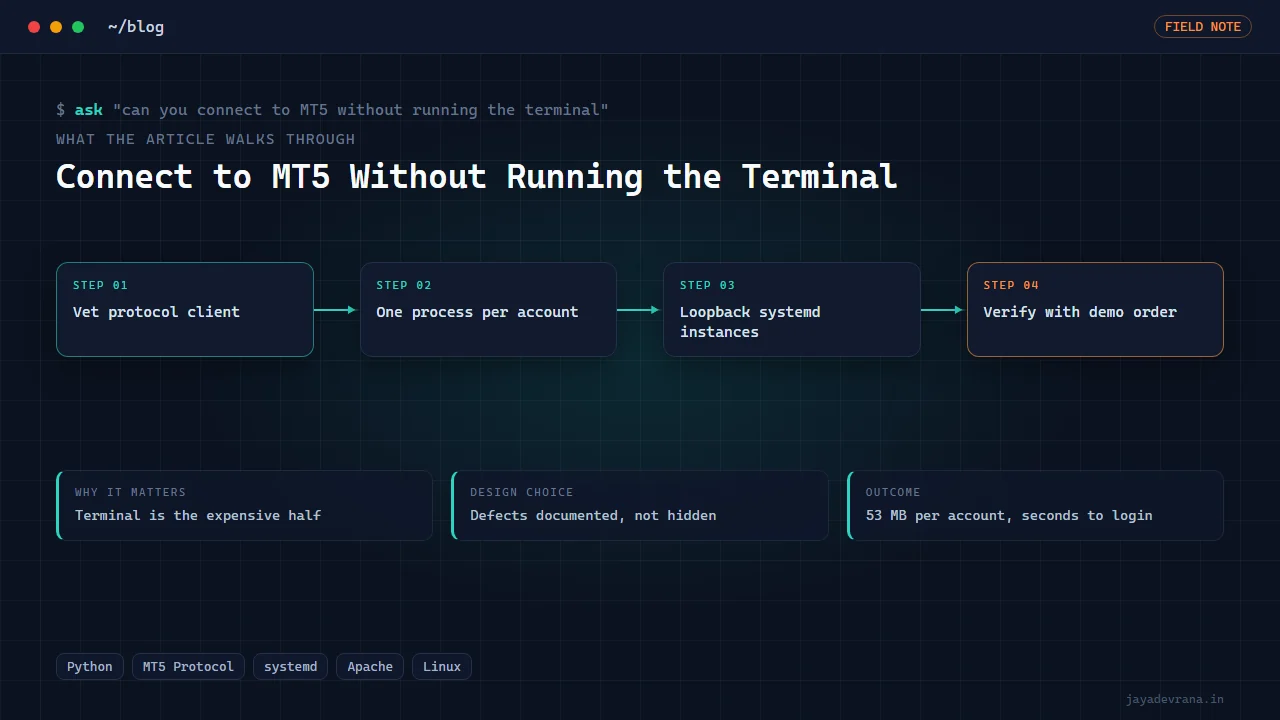
Yes, you can connect to MT5 without running the terminal. A MetaTrader 5 account is just a session on the broker's trade server, and the terminal is one client that speaks the server's protocol. A program that implements that protocol can log in, subscribe to prices, place and close orders and read deal history on its own, with no terminal window, no Expert Advisor and no Windows host. I run exactly that: a single Python service per account that accepts webhooks and talks to the broker directly, measured at 53 megabytes of memory per account and logging in within seconds, where the terminal-based alternative needed a Windows machine, a terminal instance and an EA per account.
The caveats are as important as the headline. The protocol is not officially documented for third parties, so a protocol client is a reverse-engineered library you must vet; some fields it decodes may be wrong, and you must prove which before trusting them; and nothing about it changes the fact that orders are real. This post explains why someone would want a terminal-less MT5 bridge, what it costs and saves, what breaks, and how I built and deployed one for a broker-automation product.
Why would you want to avoid the terminal at all?
Because the terminal is the expensive half of every MT5 automation stack. The standard architecture for turning webhooks into MT5 orders needs, per account, a Windows environment, a running terminal logged into that account, an EA or the Python integration inside it, and something to keep all of that alive: scheduled tasks, heartbeats, restarts after updates. Multiply by accounts and you have a pool of Windows virtual machines, remote management, and the memory footprint of many terminals.
For an individual trader with one account on a desktop PC, that is fine, and my own desktop bridge covered in connecting TradingView alerts to MT5 is built for that case. For a service running many client accounts, the Windows pool dominates cost and failure modes. Removing the terminal removes the pool.
How does a protocol-level MT5 client work?
MetaTrader 5 terminals talk to trade servers over a proprietary binary protocol. Client libraries exist that implement enough of it to authenticate, keep a session alive, request symbols and quotes, send trade requests and receive execution results, and fetch history. A bridge built on one of these runs as an ordinary Linux process:
- The service starts with one account's credentials and broker server, connects, and authenticates.
- It holds the session open, handling the keep-alive the server expects.
- An HTTP endpoint accepts webhooks from TradingView or any other source.
- Each webhook is validated and converted into a trade request in the protocol's terms: symbol, direction, volume, order type, stops.
- The server's response, including the ticket or rejection, is returned to the caller and logged.
- A history endpoint reads closed deals for reporting.
No window, no EA, no Windows licence. The resident memory in my deployment was 53 MB per account, against 121 to 202 MB for a terminal plus the overhead of the Windows host it needed. Login took seconds, where a cold pool node took five minutes or more to boot, start a terminal and log in.
What can go wrong with a reverse-engineered protocol?
Three things, and I hit two of them:
- Decoding errors. The protocol client I vendored decodes account equity and margin fields incorrectly, and reports position profit unscaled by a large factor. Rather than patch around them silently, I documented both defects and designed the service so risk logic uses balance and deal history, which decode correctly, never the suspect fields.
- Protocol drift. MetaQuotes can change the protocol with a server build. A terminal updates itself; a protocol client does not, and a session that worked yesterday can fail after a broker upgrade. Monitoring and a fallback plan are mandatory.
- Licensing uncertainty. Third-party protocol libraries come with licences of varying clarity. The question for the library I used was recorded in a notice file rather than ignored, and a commercial deployment should resolve it with counsel.
A terminal-based bridge has none of these problems and all of the cost. The choice is a trade, not a free upgrade. Everything about it is engineering rather than financial advice; orders placed through any bridge are real trades on real accounts at the account holder's risk.
How do you deploy many accounts safely on one host?
Treat each account as an isolated instance of the same service. On Linux, a templated systemd unit does this cleanly: one unit template, one instance per account, each with its own configuration, bound to the loopback interface on its own port. A reverse proxy that already fronts the host, Apache in my case, routes webhooks to the right instance, and because instances bind only to loopback, none can accidentally expose itself or fight the live website for a public port.
Setup and verification must be scripts, not runbooks. The setup script should be idempotent, so running it again updates an existing instance rather than breaking it, which makes it the update path too. The verify script should prove that the instance answers, that the site and other services on the host were untouched, and that the proxy routes correctly. Then place one real order on a demo account through the full path before calling the deployment done.
Is this the same as the MetaTrader 5 Python package?
No. The official Python integration documented at https://www.mql5.com/en/docs/python_metatrader5 communicates with a running terminal on the same Windows machine; it is a convenient API over the terminal, not a replacement for it. A protocol bridge removes the terminal. If you are on Windows with one account and the terminal already running, the official package is simpler and supported. If you need Linux, many accounts, or a small footprint, the protocol route is the one that scales.
How I built this: Terminal-less MT5 Bridge: Webhooks to Orders Over the Broker Protocol
The terminal-less MT5 bridge replaced the terminal-based execution engine behind a broker-automation product, whose Windows VM, pool nodes, remote management, scheduled tasks and heartbeat files were the expensive half of the bill. The build and deployment:
- Protocol client vetted, not trusted. A Python client library for the MT5 protocol was vendored, exercised against a demo account, and its decoded fields compared with the terminal's view of the same account. The equity, margin and position-profit defects were found here and documented.
- Single-process service per account. One Python process holds the broker session, accepts webhooks, converts them to trade requests, returns the server's response, and serves a history endpoint whose deal-based P&L is the trustworthy figure for reporting.
- Risk logic routed around the defects. Anything that gates orders on account state uses balance or deal history, never the mis-decoded fields, and the limitation is written into the service documentation.
- Templated systemd instances bound to loopback. Each account runs as an instance of one unit template behind the host's existing Apache, so instances cannot collide with the live site or expose themselves directly.
- Idempotent setup and a verify script. The setup script deploys and updates; the verify script proves the instance works and that the site, engine and Apache were undisturbed.
- Real demo order through the full path. A webhook produced a real order on a demo account via the deployed instance, confirming the chain before any client account was moved.
- Licence question recorded. The open licence status of the vendored client went into a notice file for resolution rather than being left implicit.
The measured outcome: 53 MB per account versus 121 to 202 MB plus a Windows host, login in seconds rather than minutes, and a deployment that is one template and two scripts rather than a VM pool. The design decisions that made it trustworthy were the ones that slowed it down: proving each decoded field, documenting the defects rather than hiding them, and refusing to let the new service share a port with anything that already ran on the host. For the alert-side mechanics that feed a bridge like this, why a TradingView webhook might not place orders covers the other end of the chain.
FAQ
Is a protocol-level connection allowed by brokers?
It is the same session type the terminal opens, authenticated with the account's own credentials, and brokers see an ordinary client login. Whether a given broker's terms restrict third-party clients is for you to check; this post describes the engineering and the measured results.
Can the bridge stream live prices too?
The protocol supports quote subscriptions, so a service can receive ticks for the symbols it trades. In my deployment the focus was execution and history; streaming adds session load and is worth enabling only for the symbols that need it.
What happens when the broker upgrades its server?
The session may fail to authenticate or decode until the client library is updated. Monitoring must alert on login failure, and a terminal-based fallback should exist for anything that cannot tolerate an outage while the client is fixed.
Does this remove the need for an Expert Advisor entirely?
For webhook-driven execution, yes. The bridge places orders itself. Strategies that need bar-by-bar logic can run that logic inside the service or in whatever system sends the webhooks; an EA is no longer part of the path.
If your automation is paying for Windows machines just to keep terminals alive, tell me about the setup on the contact page.
Building something in this space? I ship trading automation, Pine Script, MQL5 EAs, and full-stack tools with source and docs.
Start a project →