What to Ask Before Hiring a Pine Script Developer (2026 Checklist)
Before you hire a Pine Script developer, ask about published work, repainting tests, Pine v6, source ownership and acceptance tests so the script holds up.
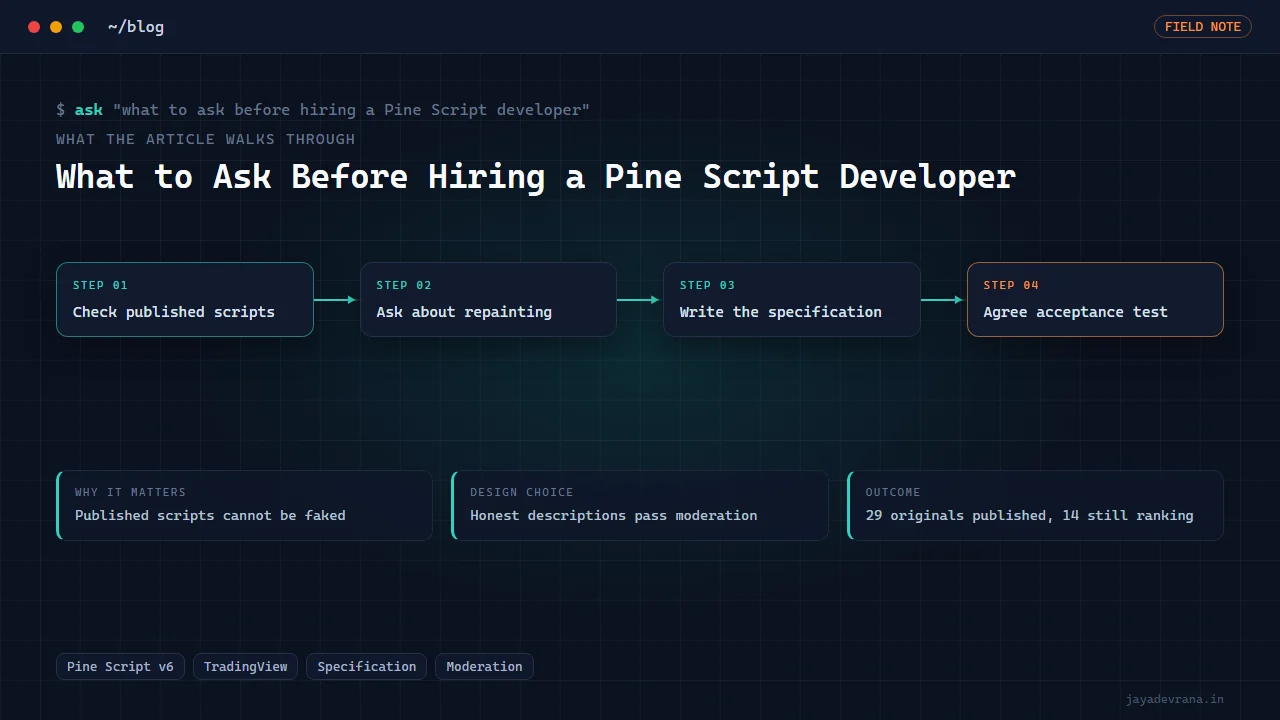
Before you hire a Pine Script developer, ask to see scripts they have published on TradingView under their own name, ask how they test for repainting, ask whether they write Pine v6 natively, ask who owns the source when the work is done, and ask how they will show you the script does what the specification says. Those five questions separate someone who has shipped reviewable Pine from someone who has only pasted it into a chart.
The reason to be specific is that Pine looks easy. A script that compiles and draws arrows is an afternoon's work; a script whose arrows mean the same thing in a backtest, in bar replay and in real time, that passes TradingView's moderation if you ever publish it, and that you can read and modify later, is a different product. This post gives you the questions, the answers you should expect, and why I point prospective clients at my own published TradingView scripts as the easiest way to check them against me.
How can I verify a Pine Script developer's work is real?
Published scripts are the only evidence a stranger on the internet cannot fake. Anyone can send screenshots. Only a TradingView profile shows scripts that went through human moderation, with the publication date, the source visible if open, and the likes and comments from other traders.
What to look for on the profile:
- Original work, not reposts. Read two or three descriptions. Do they explain the logic, the inputs and the limitations in the developer's own words, or do they read like marketing copy?
- Range. A profile with only moving-average crossovers tells you less than one with regime tools, liquidity mapping, volatility detection and a practical overlay or two.
- Longevity. Scripts that have stayed up for months without being pulled by moderators indicate the descriptions were honest.
- Open-source presence. A GitHub account with Pine repositories lets you read the code style directly, which the TradingView profile may not if the scripts are protected.
If a developer has neither, ask why. There are legitimate reasons (all work under NDA), but then you should expect a small paid trial before a large engagement.
What should I ask about repainting?
Ask the question exactly like this: "How do you make sure the signals I see in the backtest are the signals I would have seen live?" A good answer mentions the specific causes: using the current bar's close before the bar is confirmed, requesting higher-timeframe data without an offset, and plotting pivots that are only known several bars later. A better answer describes how they test it: compare bar-replay output with the historical plot, or log signal times and check them the next day.
A weak answer is "my scripts don't repaint" with no explanation. Every script can repaint if it is written carelessly; the skill is in knowing where. I wrote a full walkthrough in how to know if your TradingView indicator repaints, and I have no problem with a client reading it and then asking me those questions back.
Should I insist on Pine Script v6?
Yes, for new work. Version 6 has been the current version long enough that a developer still writing v5 by default either has not kept up or is reusing old templates. The differences are not cosmetic: boolean handling, how missing values behave, and how higher-timeframe requests evaluate all changed, and a script written with v5 habits in v6 syntax can carry subtle bugs. If the developer has existing v5 code they want to reuse, ask how they migrate it; the answer should involve more than clicking the converter. My own v5 to v6 migration guide lists what the converter misses.
What belongs in the specification before work starts?
Most disputes between traders and Pine developers come from a specification that lived in a chat thread. Before money changes hands, the written brief should contain:
- Indicator or strategy. They are different products. An indicator plots; a strategy places simulated orders and produces a tester report. Many clients ask for an indicator and then ask why there is no backtest.
- Every condition in words, with an example. "Buy when the fast EMA crosses above the slow EMA and RSI is below 60" plus a screenshot of a bar where that happened and one where it almost happened.
- Timeframes and symbols it must work on. A script tuned on a daily stock chart behaves differently on 1-minute crypto.
- Inputs the user can change. Which values are adjustable and which are fixed.
- Visuals. Arrows, labels, lines, tables, colours, and whether a dashboard is needed.
- Alerts. Which events must be alertable, and whether the messages need to be formatted for a webhook.
- Acceptance test. How you will both agree it is done: a list of bars where signals must and must not appear is the gold standard.
A developer who asks for this before quoting is doing you a favour. One who quotes a flat price from a one-line description is going to charge you later for the clarifications.
Who owns the source code, and can I read it?
Ask directly. You should receive the full source, unobfuscated, with the right to modify it and to publish it under your own name if you choose. Some developers deliver protected or invite-only scripts and keep the source; that is a licensing arrangement, not a development engagement, and it should be priced and described as one. Also ask how the code will be delivered. I deliver Pine as plain text files because TradingView has no import mechanism and clients paste the code in themselves; delivering it inside a screenshot or a locked document is a red flag.
How will the developer prove the script works?
"It compiles" is not proof. Ask for at least one of:
- A bar-by-bar walkthrough on the acceptance bars from the specification, showing each condition's value.
- For strategies, a Strategy Tester report on the agreed symbol and range, with the trade list, and an explanation of any trade that looks surprising.
- For indicators that will drive alerts, a demonstration that the alert fires on the bar you expect and not before.
- For anything that claims to match an existing tool (a paid indicator, an MT5 version), a count of matching and mismatching signals over a long sample.
Pine indicators and strategies are analysis tools. No honest developer will promise that a script makes money, and you should walk away from one who does.
How I built this: 12 Published TradingView Scripts
When someone asks me the questions above, I send them to my published TradingView scripts, because it answers most of them without my involvement. The collection began as twelve original Pine v6 scripts published under my TradingView handle, including Breakout Hazard Surface, Entropy-Driven Squeeze, Structural Liquidity Matrix, Adaptive Market Suite, a smoothed Heikin Ashi scalping overlay with an EMA crossover, and Capitulation Stretch Reversion. The process behind each one is the process I follow for client work:
- Original idea with a stated purpose. Each script addresses one question: is the market in a compressed regime, where is liquidity stacked, has a move stretched past its usual range. Information-theory regime tools and liquidity mapping sit next to practical overlays on purpose, to show range.
- Written in Pine v6 from the first line. No converted v5 templates, so the boolean, missing-value and request semantics are the current ones.
- Honest, moderation-safe description. Every publication states the logic, the inputs and the limitations plainly. TradingView moderators review scripts by hand, and a description that oversells gets pulled; one that explains gets approved and stays up.
- Submitted to community review. The scripts went through moderation and were published publicly, where anyone can open them, read the description and watch them on a live chart.
- Kept live and ranked. Fourteen of the older scripts remain live and rank first for their own names in search; four were removed over time as they were superseded.
- Extended with new batches. In October 2026 three further batches of seventeen originals went out through an auto-publish toolkit I built, including Session Auction Profile Map, Markov Regime Transition Matrix, Multi-Timeframe Liquidity Pool Ledger, Relative Strength Rotation, Compression Expansion Ladder, and five famous-trader-method indicators sharing a trade-journal layer, within TradingView's limits of five publications per day and fifteen per rolling thirty days.
The design decision that matters for a hiring client is the third step. Publishing to a moderated community forces the same discipline a good client engagement needs: say what it does, say what it does not do, and let the chart prove it. The outcome is a public, reviewable body of original Pine authorship you can check before you ever message me.
FAQ
How much does a Pine Script developer cost?
It varies with scope more than with hourly rate. A single-condition indicator with alerts is a small fixed-price job; a multi-timeframe strategy with a dashboard, risk model and parity test against another platform is a project. Get a written specification first and quotes become comparable.
Should I hire from a freelance marketplace or directly?
Marketplaces give you escrow and reviews; direct engagement gives you the developer's full attention and usually a better price. Either way, apply the same questions. A published TradingView profile matters more than a marketplace badge.
Can the developer also connect the script to my broker?
Some can, and it is worth asking, because alert messages for webhooks are best designed alongside the script. Connecting TradingView to MT5, Zerodha or a crypto exchange is a separate engineering job with its own risks; make sure the developer has shipped one before, not just read about it.
What if I want the script kept private?
Ask for the source delivered to you privately and never published. You can still run it as a private script on your own account. Invite-only publication is an option if you intend to license it to others, but that is a product decision to make after the script works.
If you have a specification, or a rough idea you want turned into one, send it through the contact page and I will tell you what it needs before I quote.
Building something in this space? I ship trading automation, Pine Script, MQL5 EAs, and full-stack tools with source and docs.
Start a project →