How to Test a Gold EA on a Cent Account Before Going Live (2026)
How to test a gold EA on a cent account before going live: real bars from the terminal, a backtest with true costs, an in/out-of-sample split, then a demo test.
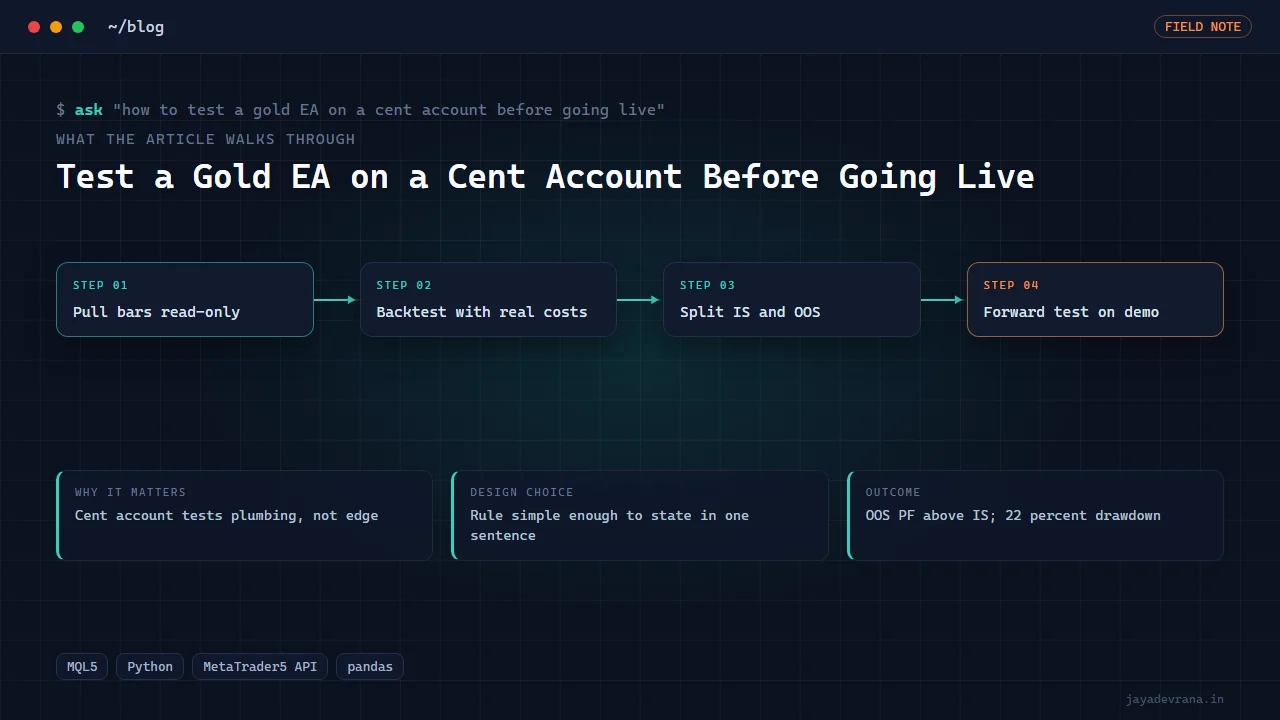
To test a gold EA on a cent account before going live, do it in this order: pull the account's own historical bars and cost parameters from the running terminal, backtest candidate rules in an engine that charges the real spread, tick value and swap of that account, split the history into an in-sample window for choosing and an out-of-sample window for judging, compile the EA, forward test it on a fresh demo for several weeks, and only then attach it to the cent account. The cent account itself is the last stage, not the first; its job is to expose live execution quirks with real money measured in cents, not to discover whether the rule works.
I did this for a small cent-denominated gold account of my own, where roughly a hundred dollars of real money sits behind the lot sizes. The rule that came out is simple enough to state in one sentence, the out-of-sample numbers were reported with their caveat attached, and the EA is still in its forward test as I write this. Here is the method, and the trap that makes most gold backtests meaningless. This is engineering, not financial advice; you trade your own account at your own risk.
Why test on a cent account at all?
A cent account denominates balance in cents, so a standard lot behaves like a micro lot in dollar terms. That makes it the cheapest way to see an EA interact with a real broker: real spreads that widen at the open and around news, real swap charged at rollover, real slippage on stops, real rejections when margin is tight. A demo account hides some of this because demo pricing and fills are often idealised.
What a cent account does not do is tell you whether your rule has any merit. A few weeks of live cent trading is a handful of trades, which is statistically nothing. The evidence for the rule has to come from the backtest and the forward test, and the cent account confirms the plumbing.
Where should the historical data for a gold backtest come from?
From the same broker and account type you will trade, pulled read-only from the terminal. Gold is quoted differently across brokers (spread, digits, contract size, trading hours and swap differ) and a backtest on another vendor's data silently assumes another vendor's costs. The MetaTrader 5 Python package can read bars and symbol properties from a running terminal without placing orders, which is how I pull hourly and daily bars plus the exact spread, tick value and swap long and short for the symbol on that account.
Read-only is the operating rule. The live terminal is never used to test anything; it supplies data and nothing else. The package documentation at https://www.mql5.com/en/docs/python_metatrader5 covers the calls.
How do you make the backtest cost-aware?
Most gold EAs look good because the backtest charges nothing. A cost-aware engine applies, per trade:
- The spread as the account actually quotes it, applied at entry and exit, not a flat assumption.
- Commission if the account type charges one.
- Swap per night held, long and short separately, using the account's published rates, with the triple-swap day handled.
- Slippage as a conservative constant on stop orders.
- Position size from a fixed risk fraction and the stop distance, using the account's tick value so profit and loss come out in the account currency.
On a cent account the proportions are identical to a standard account; only the denomination changes. A rule that cannot survive these costs on paper has no business on an account with real money, however small.
How do you split the data so you are not fooling yourself?
I used 2022 to 2024 as in-sample and 2025 onward as out-of-sample. Candidates were compared and chosen on the in-sample window only; the out-of-sample window was touched once, to report. The rule that survived is stated fully because a rule you cannot state is one you cannot trust:
On the hourly chart, enter when the close has moved more than one average true range over the last 24 bars, in the direction of the daily trend defined by the 20-period exponential average being above or below the 50-period one. Stop at two ATR from entry, trail at three ATR, flip on an opposite signal, risk one percent of equity per trade.
Out-of-sample profit factor came out higher than in-sample, maximum drawdown about 22 percent at that risk setting, and the longest losing streak 13 trades. Those numbers are reported next to their caveat, which is the next section.
What is the caveat every gold backtest since 2024 needs?
Gold spent 2022 and 2023 largely flat and then entered a strong bull run from 2024 into 2026. Nearly all of the backtest's profit came from that run, mostly on the long side. A momentum-trend rule is designed to catch exactly that, so the result is consistent with the rule doing its job, and it is also a warning: if gold returns to a flat regime, expect the 2022 to 2023 behaviour, which was a slow bleed. The caveat is written beside the result in the project, and the one percent risk setting was chosen with the 22 percent drawdown and the 13-trade streak in view.
Why forward test on a demo before the cent account?
Because the live terminal cannot host a headless strategy tester run without disturbing the account it is attached to, and because a forward test on a fresh demo answers questions the backtest cannot: does the EA handle the broker's symbol suffix, the server time offset for the daily trend, rollover gaps, and reconnects? Four weeks is my minimum; it is long enough to see a few trades and at least one weekend and one news spike. The EA compiles clean today and sits in that forward test. Only after it passes does it attach to the cent account, with the same one percent risk.
How I built this: Momentum-Trend Gold EA chosen by cost-aware backtest
The Momentum-Trend Gold EA is the project behind this post: an MQL5 expert advisor plus a Python research engine for a small live cent account. The workflow was:
- Pull hourly and daily gold bars and the symbol's spread, tick value and swap rates read-only from the running live terminal through the MetaTrader 5 Python package.
- Backtest a set of candidate rules in a pandas-based engine that charges the account's real costs and sizes positions at a fixed risk fraction.
- Compare candidates on the 2022 to 2024 in-sample window and select for consistent behaviour, then report the 2025 onward out-of-sample result once.
- Write the regime caveat next to the numbers: flat years lose slowly, the bull run made the profit.
- Compile the EA in MQL5 with the rule exactly as stated, including the trailing stop and flip logic.
- Forward test on a fresh demo for four weeks before any attachment to the live cent account.
Design decisions: data from the account you will trade, costs from the same account, a strict split with out-of-sample touched once, a rule simple enough to state in a sentence, and a forward-test gate before live. The outcome is a chosen rule with honest numbers and an EA waiting on evidence rather than enthusiasm. For how I bring TradingView signals into MetaTrader instead of running native EAs, see building a custom TradingView to MT5 bridge, and for a different gold build where the rule was decoded from a live account's pattern, the gold grid pattern EA decode is the contrast case.
FAQ
Can I skip the demo and go straight to the cent account?
You can, and the money at risk is small, but you lose the clean read on execution issues. A failed trade on the cent account mixes broker behaviour with EA bugs; the demo stage isolates the bugs first.
What risk per trade is sensible on a cent account?
The percentage should be the one you would use on the eventual real account, because the point is to rehearse behaviour. I use one percent, which produced a 22 percent maximum drawdown in the backtest; a higher setting scales the drawdown with it.
How long should the forward test be?
Long enough to include several trades, a weekend rollover and at least one high-impact news event. Four weeks is my floor for an hourly system; a daily system needs longer.
Why not use the built-in strategy tester for the whole process?
The MetaTrader tester is excellent for execution-level checks and I use it for other EAs. For this account the live terminal could not run headless tester jobs without interference, and the Python engine made the cost model and the in-sample and out-of-sample split explicit and scriptable.
If you want an EA selected and tested this way for your account, tell me about it on the contact page.
Building something in this space? I ship trading automation, Pine Script, MQL5 EAs, and full-stack tools with source and docs.
Start a project →