How to Convert a Pine Script Strategy Into an MT5 Expert Advisor
Convert a Pine Script strategy to an MT5 Expert Advisor without drift: map series to buffers, match bar timing, port exits and prove parity in the tester.
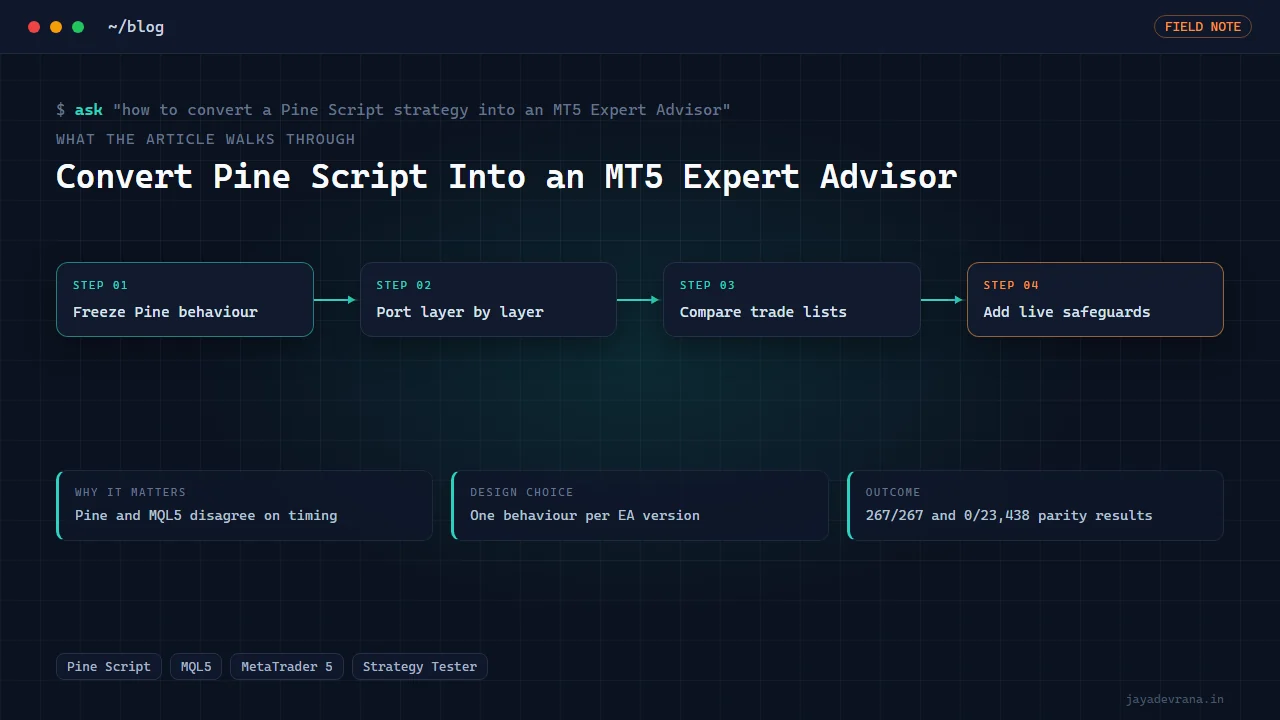
Converting a Pine Script strategy into an MT5 Expert Advisor is not a translation job, it is a re-implementation with a parity test at the end. Pine runs your logic once per bar over a series the platform manages for you; MQL5 gives you an event loop, raw price arrays you index yourself, and a broker that can reject or partially fill what Pine would have simply assumed. The reliable method is to freeze the Pine behaviour as a reference, rebuild each component in MQL5 in a fixed order (data, indicators, signals, position logic, exits, sizing), and then prove bar-by-bar that the EA's trades match the Pine trade list before anyone attaches it to an account.
Done that way, a port can be exact. I have delivered Expert Advisors that matched their TradingView source on every one of several hundred signals, and others with zero direction mismatches across more than twenty thousand bars. Done by eye, a port usually "looks right" and quietly diverges on the one condition the trader cares about most. This post is the method I use, followed by the long-running client engagement where I learned most of it the hard way.
Why does a Pine strategy behave differently once it is in MQL5?
Because the two platforms disagree on things Pine hides from you:
- Bar timing. Pine evaluates on each bar and, by default, a strategy order placed on bar N fills at the open of bar N+1. An EA running on every tick can act mid-bar unless you explicitly gate it to new-bar events, and then you have to decide whether "new bar" means the same thing as Pine's bar close.
- Indexing. Pine's index zero is the current bar and history grows to the right in your head but to the left in the arrays. MQL5 arrays can be series-ordered or not, and copying indicator buffers requires you to choose. Off-by-one errors here are the single most common porting bug.
- Built-in indicators. Pine's RSI, ATR and moving averages use specific smoothing methods. MT5's built-ins use their own. Wilder's smoothing versus a simple average on ATR alone can shift every stop level.
- Order model. Pine's strategy engine nets positions and models exits with ideal fills. MT5 accounts can be netting or hedging, fills are real, spread is real, and the broker's minimum stop distance can reject a stop Pine happily placed.
- Timezone and session. Pine's chart time and the broker server time differ; a "trade only 9:30 to 11:00" filter means something else on the EA unless you convert.
None of these are hard individually. They are hard because they compound, and because a backtest in the MT5 Strategy Tester will run cleanly and produce plausible trades even when three of them are wrong.
How do I map Pine series and built-ins to MQL5?
I keep a fixed order and do not move to the next layer until the current one matches.
- Data layer. Confirm the EA's bar data matches the chart's: same symbol, same timeframe, and the same number of bars loaded. Export a few hundred Pine bars (time, open, high, low, close) and compare to what the EA reads.
- Indicator layer. For each Pine built-in, write or configure the MQL5 equivalent with the same smoothing. Where MT5's standard indicator differs, compute it yourself. Print both values for the same bars and compare to at least four decimals.
- Signal layer. Translate the boolean conditions. Pine's crossover and crossunder functions compare the previous bar as well as the current; replicate that exactly rather than reaching for a simpler comparison.
- Position layer. Decide netting versus hedging and how a reverse is executed. Pine's "strategy.entry" with an opposite ID reverses implicitly; the EA has to close then open.
- Exit layer. Port stops, targets and trailing. Pine's exit levels are evaluated against intrabar highs and lows in a specific order; the EA must honour the broker's stop-level and freeze-level constraints.
- Sizing layer. Last, because it changes nothing about signal correctness. Fixed lots, percent-of-equity or risk-per-trade, rounded to the symbol's lot step.
MetaQuotes documents the series access and indicator handle model in the MQL5 reference at https://www.mql5.com/en/docs, and it is worth reading the timeseries section before writing a single line, because the array direction choice determines every index in the EA.
How do I prove the EA matches the Pine strategy?
Parity is a number, not a feeling. My acceptance test is:
- Export the Pine strategy's list of trades (entry time, direction, entry price, exit time, exit price) from the Strategy Tester on TradingView.
- Run the EA in the MT5 Strategy Tester on the same symbol, timeframe and date range, with spread fixed to a small constant and commissions off, so the comparison isolates logic from friction.
- Align the two trade lists by entry bar and compare direction first, then entry bar, then exit bar.
- Count mismatches. Zero direction mismatches is the bar for signal logic; a handful of one-bar exit differences usually traces to intrabar ordering and must be explained, not waved away.
For one indicator-to-EA port in 2026 the result was 267 of 267 signals in agreement. For another, the EA was compared against the Pine source on 23,438 bars with zero direction mismatches. When the count is not zero, the mismatches point at the layer with the bug, which is why the layered build order matters.
Can I just use an AI tool to convert Pine to MQL5?
You can use one to draft the skeleton, and I do, but the output needs the same parity test as hand-written code. Language models are good at translating syntax and poor at the semantics that differ between platforms: they will produce an ATR with the wrong smoothing, an index direction that is reversed, and a reverse that merely flattens. If you take the draft and then run the six-layer comparison, you catch all of it. If you take the draft and attach it to a live account, you find out from your statement. The same caution I wrote about for AI-written Pine that will not compile applies twice over here, because MQL5 code that compiles and trades is more dangerous than Pine that errors.
What should the EA do that the Pine strategy never had to?
Production concerns Pine does not model but a live EA must handle:
- Slippage tracking. Record requested versus filled price per trade so the trader can see execution quality rather than guess.
- Partial fills and rejections. Re-check the position after every request; never assume the request succeeded.
- Restart safety. If the terminal restarts mid-trade, the EA must rediscover its own positions and continue managing them.
- Session gates. Only trade when the broker's symbol session is open; gold on several brokers opens one minute after the bar.
- Spread filter. Skip entries when spread exceeds a threshold; the backtest's fixed spread never saw a news spike.
Expert Advisors place live orders. Everything in this post is engineering, not financial advice; whoever runs the EA trades their own account at their own risk.
How I built this: A Prop-Firm Trader's MetaTrader 5 EA Lineage
The method above was shaped by a multi-year engagement I describe in a prop-firm trader's MetaTrader 5 EA lineage. The client did not hand me a Pine file; he handed me handwritten rulebooks for a family of weekly Awesome Oscillator, W15 and daily-weekly-monthly strategies, revised after every review. Over more than a dozen versions the workflow settled into this shape:
- Freeze the rulebook. Each version started from the client's written rules, turned into a numbered specification we both signed off before code changed. Ambiguities ("after the candle confirms") were resolved in writing, exactly as you would pin down Pine's bar-close semantics before porting.
- Implement one rule family per version. Step-pairs, target-fix logic and auto-slippage tracking each arrived as their own version so a behaviour change could be attributed to one diff.
- Validate on the Strategy Tester against the rulebook. Every version was run on the agreed symbols and dates and the trade list walked against the rules by hand before delivery.
- Review, then iterate. The client's feedback from live and demo use drove the next version. Nothing was changed without a corresponding rule.
- Mirror across terminals. A local Master/Slave trade copier was added so the signals could be replicated to a second terminal without re-running the strategy.
- Reuse the harness. The headless tester harness built here, with its own agent port and a PowerShell launcher because Git Bash mangles the portable flag, became the shared test rig for later ports, including the JOYBOY and Ultimate Buy/Sell EAs with the parity numbers quoted above.
The design decisions that carried over into every later Pine-to-MQL5 job: a written specification before code, one behaviour per version, a tester run as the acceptance gate, and slippage recorded per trade because live fills are the one thing no port can promise. The outcome was an EA family the client ran across review rounds for years, and a porting discipline I now apply to any TradingView strategy that needs to become an Expert Advisor.
FAQ
How long does a Pine to MQL5 port take?
A clean single-timeframe strategy with standard indicators and simple exits is a few days including parity testing. Multi-timeframe logic, custom indicators, pyramiding or complex trailing can double that, mostly in the comparison phase rather than the writing.
Will the MT5 backtest match the TradingView backtest exactly?
The trade list can match exactly if the logic is ported correctly and friction is held constant. The profit figures will differ because MT5 models spread, commission and swap from the broker's real symbol settings and TradingView uses your strategy's assumptions. Compare trades, not net profit.
Can one EA run the strategy on multiple symbols?
Yes, either by attaching one instance per chart or by writing the EA to loop over a symbol list from a single chart. Per-chart instances are simpler to test and debug; a multi-symbol EA needs careful handling of magic numbers and per-symbol state.
Do I need the Pine source, or is an indicator on the chart enough?
The source makes it precise. Without it, the port is a reverse-engineering job: read the plotted values off the chart, hypothesise the logic, and verify against the plots. It can be done and I have done it, but it costs more and the parity test becomes the only thing standing between a guess and a correct EA.
If you have a Pine strategy you want running as an MT5 Expert Advisor with a parity report attached, tell me about it on the contact page.
Building something in this space? I ship trading automation, Pine Script, MQL5 EAs, and full-stack tools with source and docs.
Start a project →