How to Make Documentary Videos With AI on a Local GPU (2026 Pipeline)
How to make documentary videos with AI on a local GPU: cited research, narration-first script, local video and music generation, loudness-normalised assembly.
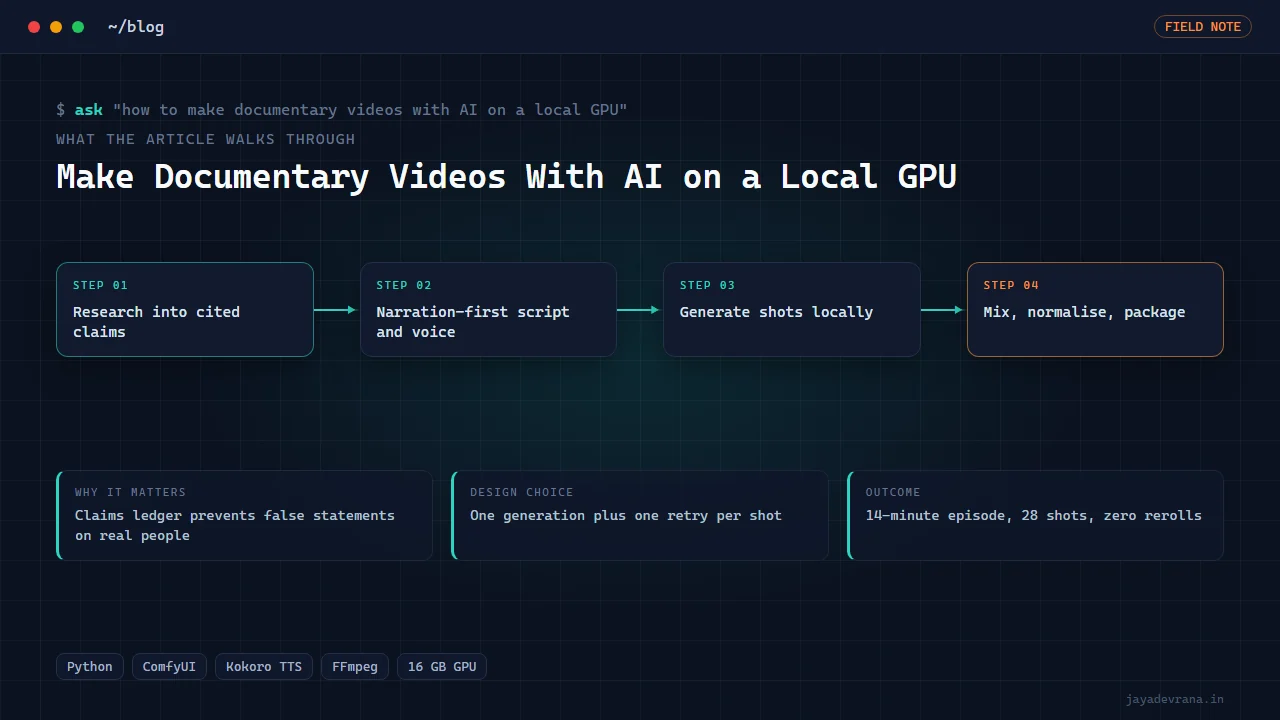
You can make a full documentary video with AI on a single local GPU, and the shape of the pipeline is always the same: research the topic into a list of claims with sources, write a narration-first script, generate the narration, plan one shot per narration beat, generate those shots and the music locally, then assemble, normalise loudness and package metadata. A 16 GB consumer card is enough if you generate shots one at a time and treat each stage as a step that can be re-run on its own.
My first attempt at this was an end-to-end Python engine that turned a topic into a 1080p MP4 with an API doing the image and voice work. The current version, which produced a 14-minute finance episode with 28 locally generated video shots and zero rerolls, runs entirely on my own machine. This post walks through how to make documentary videos with AI that are watchable, defensible and repeatable, and where the first version went wrong.
What does an AI documentary pipeline actually consist of?
Strip away the tooling and there are six stages:
- Research: gather facts into a claims list where every claim has a source URL.
- Script: write narration that reads aloud at a natural pace, structured as beats of one to three sentences.
- Voice: synthesise narration per sentence so prosody varies and a single misread can be regenerated.
- Visuals: plan one shot per beat, generate it, and check it before moving on.
- Music and sound: generate beds locally or use properly licensed material; never lift third-party footage.
- Assembly: cut to the narration clock, mix, normalise loudness, write captions, chapters, thumbnail and a description with sources.
The order matters. Writing visuals before narration produces a slideshow with a voice stapled on. Narration first gives you a timing spine, and every later decision hangs off it.
Why should the script be narration-first and claim-led?
Documentaries get taken down or dismissed for two reasons: they bore people, or they say something false about someone. Both are script problems. The research stage in my pipeline produces a claims ledger, and the script is only allowed to state what is in the ledger. The published description lists the sources (22 of them on the first episode), which is both a trust signal and a defence.
For the hook, I follow a measured rule from studying ten documentary channels: open with the question the viewer already has, promise what they will understand by the end, and do not spend the first minute on a title card. Cold-open on the episode's own strongest visual with the title as a lower third.
The narration-first discipline also catches a quiet failure: a script that reads well on screen but is too long when spoken. I budget by words per minute and cut before generating anything.
How do you generate narration that does not sound like a robot?
Three habits make the difference:
- Render sentence by sentence, not paragraph by paragraph. Long requests to a text-to-speech model flatten intonation and, with some models, silently truncate.
- Transcribe every rendered sentence back and compare it to the script. A phrase the model misreads (tickers, acronyms, Hindi names) is regenerated with a phonetic spelling. This is the single highest-value QA step in the whole pipeline.
- Vary pause lengths between sentences and add a soft breath before paragraph starts. Constant gaps are what make synthetic speech feel synthetic.
I use an open-weights voice locally so the whole run is offline and cost-free per sentence; the voice is cached so re-running a script only re-renders changed lines.
Can you generate documentary visuals on a 16 GB GPU?
Yes, with constraints. The models I run locally produce short clips, roughly five seconds at a time, so the shot plan has to be built from short beats. A few rules that came out of measured runs:
- Submit shots one at a time so the model stays resident in memory; batching causes reloads that cost more than they save.
- Give every shot a deterministic seed and a byte-identical character description. Subject drift between cuts is almost always caused by small wording changes.
- Treat the first generation as the probable final. My generation law is one generation plus at most one diagnosed retry per shot; if a shot needs a third attempt, the prompt is wrong and the pipeline raises an error rather than burning hours.
- Use a still-image model for the hero frame first, then animate it. Keyframe-first gives far more control over composition than text-to-video alone.
The audio-capable video model I use can also produce short music clips and ambient sound, which solves the licensing problem: every music bed in the episode is generated, and no third-party footage appears at all.
How do you mix narration and music so levels do not jump?
This was the fix I added after the owner of the channel flagged level swings in the first cut. The standard now is:
- Music beds normalised to a fixed quiet target well below the voice.
- A speech-pocket equaliser on the bed to carve space in the narration frequency range.
- A single constant gain for the whole bed, never automated ducking that pumps.
- A two-pass loudness normalisation on the final mix to a broadcast-style integrated target; the first episode landed at minus 13.9 LUFS.
Measure the result rather than trusting it: a loudness report per segment catches a segment that was rendered at the wrong gain before it reaches YouTube.
What should the final package include?
A documentary is not finished when the MP4 renders. The packager writes captions from the sentence-level narration timings, a chapter list from the beat structure, a thumbnail from the hero frame, and a description that carries the source list. Each run keeps its artifacts (script, claims, shot specs, generated clips, transcripts, loudness reports) in a dated folder so a critique later can be traced to the exact decision. On the first episode, an external review by two other model tools caught a factual error before publishing, which only worked because the claims ledger existed to check against.
How I built this: AI YouTube Documentary Engine
The AI YouTube Documentary Engine started as a Python pipeline that took a single topic and produced a finance-and-psychology documentary end to end, with hosted image and voice generation and local fallbacks when an API was unavailable. It has a test suite, an architecture diagram, and a runs directory so every production is traceable.
In 2026 it was superseded in practice by a skill-driven version that keeps the same skeleton but moves generation local. The workflow now is:
- Benchmark and research: a ten-channel study set the structural rules, and a topic brief produces a claims ledger with sources.
- Script: narration-first, defamation-safe by construction, budgeted by spoken words per minute.
- Voice: local open-weights narration rendered per sentence and verified by transcription.
- Visuals: hero frames generated first, then animated locally; one generation plus one diagnosed retry per shot.
- Music: short generated beds, no licensed or third-party audio.
- Assembly: a 55-piece cut on the narration clock, speech-pocket mixing, two-pass loudness, captions, chapters and a cited description.
Design decisions: claims before prose, narration before visuals, deterministic seeds, a hard cap on retries, and measured loudness instead of ear-balling. The outcome was a 14-minute, 1080p episode built from 28 local video generations with zero rerolls and a 22-source description. The GPU foundation it runs on is described separately in my local AI video stack, and the narration tooling overlaps with the lesson video pipeline.
FAQ
How long does a 14-minute AI documentary take to render locally?
Measured on a 16 GB card, the video generations dominate: each five-second shot takes a few minutes, so 28 shots is a couple of hours of GPU time, plus narration, assembly and QA. A full episode is an overnight job rather than a lunch break, and most of the human time goes into the script and claims review.
Do I need an API at all?
No. The current pipeline runs narration, images, video, music and transcription locally. Hosted models are useful for research and critique, and the original engine falls back to local generation when an API key is missing, so the dependency runs in the safe direction.
How do you avoid copyright strikes?
Generate everything: visuals, music and voice. Quote sources in the description rather than embedding their footage. The claims ledger also keeps the narration on the right side of defamation rules, which matters more than copyright for finance topics about real companies.
Can the same pipeline make shorter explainers?
Yes. The stages are identical; only the shot count and narration budget change. I use the same assembly and loudness standard for vertical shorts, with a tighter hook rule because the first second decides retention.
If you want a documentary or explainer pipeline like this set up for your channel, tell me about it on the contact page.
Building something in this space? I ship trading automation, Pine Script, MQL5 EAs, and full-stack tools with source and docs.
Start a project →