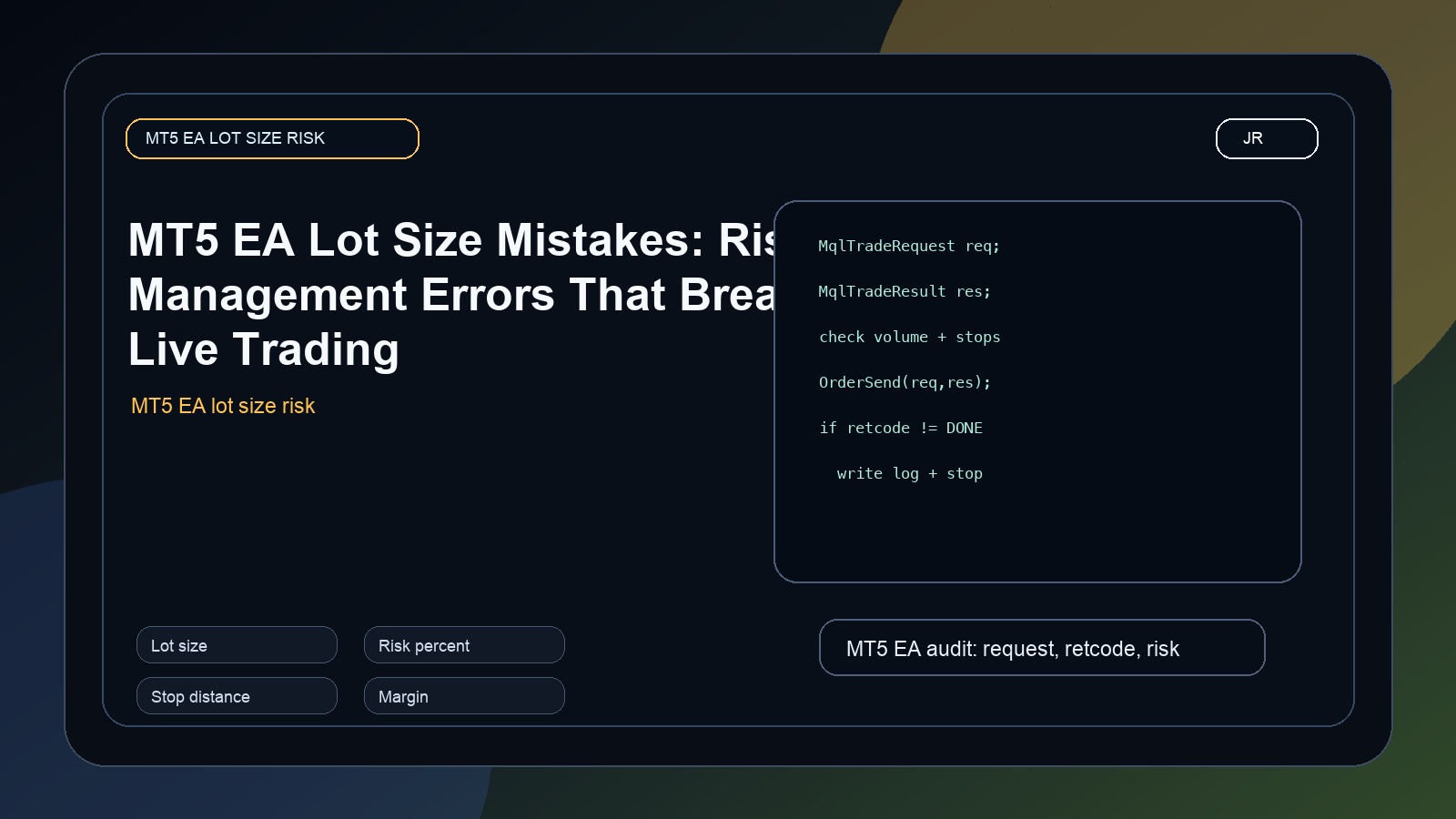
MT5 lot sizing mistakes happen when an EA treats volume as a fixed input instead of calculating risk from equity, stop distance, symbol value, and broker limits.
MT5 traders search for lot size calculators because fixed lots eventually become uncomfortable. A 0.10 lot trade is not the same risk on every symbol, every account size, every stop distance, or every broker contract. If an EA ignores that, the backtest may look smooth while live risk becomes inconsistent.
The mistake is thinking risk is only a number in the input panel. Real risk is the relationship between account equity, stop distance, tick value, symbol rules, spread, slippage, and broker margin requirements.
double RiskVolume(double riskPercent, double stopPoints)
{
   double equity = AccountInfoDouble(ACCOUNT_EQUITY);
   double riskMoney = equity * riskPercent / 100.0;

   double tickValue = SymbolInfoDouble(_Symbol, SYMBOL_TRADE_TICK_VALUE);
   double tickSize  = SymbolInfoDouble(_Symbol, SYMBOL_TRADE_TICK_SIZE);
   double volumeStep = SymbolInfoDouble(_Symbol, SYMBOL_VOLUME_STEP);

   double valuePerPoint = tickValue * (_Point / tickSize);
   double rawLots = riskMoney / (stopPoints * valuePerPoint);

   double lots = MathFloor(rawLots / volumeStep) * volumeStep;
   return NormalizeDouble(lots, 2);
}Why fixed lots are dangerous
Fixed lots can be fine for testing a concept, but they do not describe risk. A 50 point stop and a 500 point stop cannot use the same lot size if the trader wants equal risk. A forex pair and a CFD index may not have the same point value. Even the same symbol can behave differently across brokers.
That is why I prefer EAs that calculate risk from the stop. The stop defines the amount of price movement the trade can absorb. The lot size should follow that distance, not the other way around.
Mistakes in risk-based sizing
- The EA uses balance when equity would be more appropriate for active drawdown control.
- The lot calculation ignores symbol volume step and minimum volume.
- The EA does not check whether margin is sufficient before sending the order.
- The stop distance is zero, tiny, or not validated before volume calculation.
- The formula works on EURUSD but fails on gold, indices, or synthetic symbols.
A production EA should not blindly trust its lot formula. It should clamp volume to broker limits, normalize to the volume step, check margin, and log the calculation. If the result is unsafe, it should refuse to trade.
What I deliver in serious EA builds
I like risk modules that are boring and auditable. The Journal should be able to tell the trader: account equity, risk percent, stop distance, calculated volume, adjusted volume, margin check, and final request. When those numbers are visible, the EA becomes much easier to trust.
Jayadev Rana's approach to EA development is not only about entries. Entries are the visible part. Risk control is the part that keeps the system alive long enough to matter.
Good risk code is not glamorous, but it is one of the clearest signs of a serious developer. Entries may attract attention, but risk logic decides whether the robot behaves professionally when the market becomes uncomfortable.
Margin is another layer. A lot size can match the risk formula and still fail because free margin is not enough. This is common when traders test on one account size and then run live on another, or when they move from forex pairs to indices or metals. A production EA should check margin before sending the order, not discover the problem from a rejected trade.
I also like separating the raw calculated lot from the broker-adjusted lot. The raw lot tells us what the formula wanted. The adjusted lot tells us what the broker rules allow after minimum volume, maximum volume, and volume step. If those two values are very different, the trader should know before judging the strategy.
Risk-based lots are only useful if the EA validates the inputs first. If the stop distance is missing, zero, or too small, the calculated lot size can become absurd. If tick value is unavailable or unusual for the symbol, the formula can mislead the trader. A safe EA checks these cases and refuses to trade when the calculation is not trustworthy.
The risk checks I want before a live EA trade
For a proper review, I ask for account currency, broker symbol, minimum lot, volume step, example stop distance, screenshot of the trade specification, and the current lot formula. With those details, it becomes possible to test whether the EA is risking what the trader thinks it is risking. Without them, lot sizing becomes a guess disguised as code.
What traders should send for a risk audit
A trader should be able to read the EA log and understand the risk decision before the order appears. If the lot size cannot be explained, it should not be sent to the broker yet.
Ask Jayadev Rana to review your MT5 EA risk and lot sizing
Send the chart idea, market, timeframe, and goal on WhatsApp. I can usually tell you quickly whether the next step is a custom Pine Script build, a strategy audit, or a broker-ready automation layer.
Related services
Frequently asked questions
Can Jayadev Rana fix my existing script or EA?
Yes. Send the code, screenshot, error message, and what you expected the system to do.
Will the solution be explained?
Yes. The goal is not only to patch code, but to make the trading logic easier to maintain.
How do I request a quote?
Send the script or EA requirement on WhatsApp with the market, timeframe, and broker details.
Primary sources and references
I take on Pine Script indicators, TradingView automation layers, strategy audits, and broker-aware execution workflows when the goal is clear and the live behavior actually matters.